

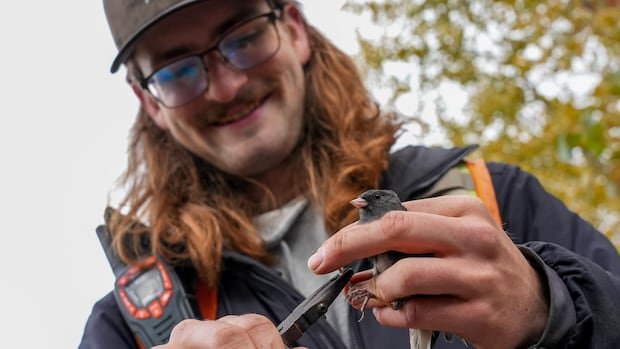

In the boreal forest near a network of nets, Ethan Denton, a Calgary-based ornithologist, carefully bands a dark-eyed junco, a small dark grey songbird. Denton uses pliers to attach an aluminum band with an identification number to the junco’s right leg, recording its details before releasing it. This data aids researchers in tracking the bird’s migration patterns across North America.
Ken Foster, a co-founder of the Wood Buffalo Wildlife Research Institute (WBWRI), oversees Denton’s work, emphasizing the importance of monitoring bird populations in the oilsands region. Foster highlights the institute’s mission to identify declining bird species and explore conservation strategies.
Although bird research in the oilsands region is not new, WBWRI stands out as a non-profit organization dedicated to long-term bird monitoring. Foster, along with his wife Christine Godwin, established the institute in 2024 to continue their research efforts with a focus on engaging volunteers in wildlife studies.
Foster’s research, conducted through Owl Moon Environmental Inc. (OMEI), reveals significant population declines in certain songbird species due to habitat changes caused by wildfires and industrial activities. While some species, like the least flycatcher and northern waterthrush, have declined by up to 90% in the past 15 years, others, such as clay-coloured sparrows, have adapted well to disturbed habitats in the region.
WBWRI’s collaboration with energy companies and community volunteers underscores its commitment to education and conservation efforts. Ryan Campbell, a recent high school graduate who interned with WBWRI, praises the experience for fostering his interest in bird observation and conservation.
Erin Bayne, a biology professor at the University of Alberta, emphasizes the importance of local studies like Foster’s in understanding bird population trends and environmental changes. By integrating local data with national databases, researchers can address conservation challenges and inform policy decisions.
In addition to bird banding projects, WBWRI is expanding its initiatives to include automated wildlife tracking systems and monitoring bat populations. Foster envisions a future where the organization can raise funds to support wildlife rehabilitation efforts and further contribute to conservation in the Fort McMurray region.