

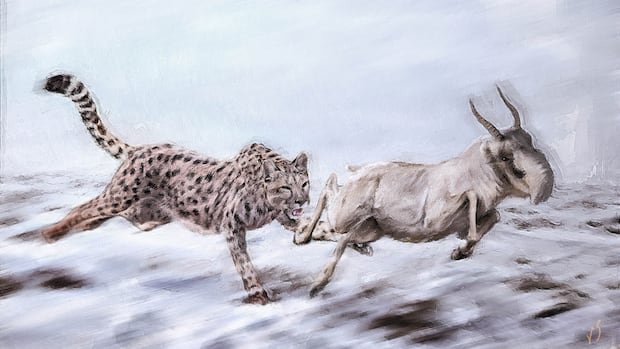

Bones discovered in the Bluefish Caves and a mine site in northern Yukon were initially believed to belong to an ice-age puma or cougar. However, DNA analysis conducted by the University of California presented a surprising revelation. The testing was carried out by Molly Cassatt-Johnstone, a former lab technician who had recently completed her undergraduate studies. These Yukon bones marked some of the earliest samples she had worked on, leading to her initial disbelief when the results did not align with those of pumas.
Yukon paleontologist Grant Zazula vividly recalls his astonishment upon receiving the message that the cougars were not cougars at all but rather cheetahs. Reflecting on the advancements in genetic analysis, Zazula noted the transition from a once seemingly fictional concept to a routine practice of analyzing permafrost-preserved bones from the Yukon.
Cassatt-Johnstone’s identification of a Yukon Miracinonyx, also known as the extinct American cheetah, marked a significant milestone. She now serves as the lead author of a paper published in Current Biology, shedding new insights on the ice-age cat’s dietary habits and habitat range.
Researchers had traditionally believed that the American cheetah, resembling modern cheetahs with their elongated limbs and slender physique, had evolved to pursue pronghorns across grassy plains. The discovery of these animals in the Arctic tundra puzzled paleontologists, as they had been initially thought to be specialized predators of American pronghorn antelope, a species absent in Beringia.
To unravel the mystery of how Miracinonyx thrived in this region, the study’s authors, in collaboration with Canadian and U.S. partners, employed stable isotope analysis. This forensic technique delves into chemical indicators to explore the dietary patterns and environmental conditions of ancient creatures. Through meticulous analysis of bone fragments from the cheetah’s limbs, researchers unearthed the surprising revelation that Yukon cheetahs predominantly feasted on fish, a behavior uncommon among both past and present-day felines.
Paleontologist Julie Meachen, renowned for her expertise in Late Pleistocene mammalian carnivores, expressed astonishment at this revelation. She highlighted the stark behavioral differences of the Yukon cheetahs compared to those in midcontinental North America, emphasizing their unique adaptation to the bountiful runs of Yukon salmon as a strategic survival tactic in a competitive landscape.
Furthermore, the study’s extensive DNA analysis revealed that Miracinonyx was genetically more akin to North American pumas than African cheetahs. The research also examined the genetic diversity of the cheetah population, indicating consistently low numbers which may have contributed to their extinction.
Grant Zazula proposed renaming this distinct northern lineage from ‘American Cheetah’ to ‘Yukon Cheetah’ in light of their specialized fishing behavior. He emphasized the significance of even the smallest bone discovery in uncovering new narratives within the realm of paleontology.