

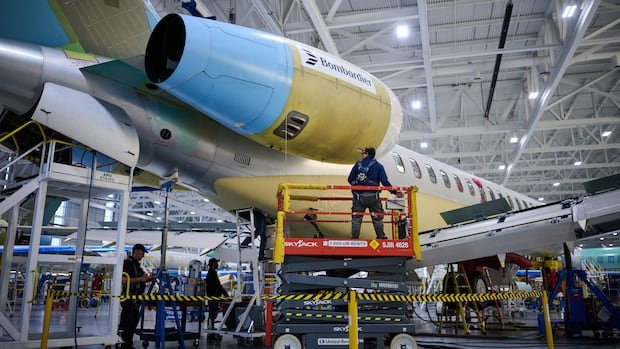

U.S. President Donald Trump announced on Monday that Bombardier, a Montreal-based aircraft manufacturer, will no longer be permitted to sell its products in the United States unless it commences production within the country. Trump’s statement on Truth Social emphasized that Bombardier’s products do not meet the required standards for the U.S. market and called for the company to establish manufacturing operations in the U.S. rather than treating the country solely as a financial resource.
This declaration from Trump is part of his ongoing efforts to encourage both foreign and domestic companies to increase manufacturing activities within the United States. The move comes amidst escalating trade tensions between Washington and Ottawa, reflecting Trump’s push for a more robust domestic manufacturing sector. Canada is preparing to implement retaliatory tariffs against the U.S. in response.
Quebec Premier Christine Fréchette expressed her support for Bombardier, labeling the company as a source of pride for Quebec and underscoring its significant contribution to the local economy and aerospace industry. Fréchette refrained from engaging in further provocations in response to Trump’s remarks and extended her full support to Bombardier’s CEO, Eric Martel.
Despite Trump’s directive, Bombardier already has a substantial presence in the U.S., with a workforce of 3,500 employees and 2,800 suppliers in the country. The company issued a statement reaffirming its commitment to the U.S. market and highlighting the numerous American jobs created by its aircraft manufacturing operations. Moreover, Bombardier’s compliance with the Canada-United States-Mexico Agreement (CUSMA) trade deal, facilitated by Trump, has been emphasized.
Aerospace analyst Richard Aboulafia expressed skepticism regarding the feasibility of halting Bombardier jet sales, noting the intricate global integration of the aerospace industry. He highlighted that most Bombardier private jets utilize U.S.-made engines from companies like Honeywell Aerospace and GE Aerospace, emphasizing the interdependence within the sector.
Looking ahead, experts predict that Bombardier might be just the beginning of Trump’s targets in the ongoing trade dispute, with potential repercussions for other Canadian companies operating in the U.S. John Gradek, a supply chain networks and aviation management lecturer at McGill University, suggested that Trump’s actions could have wider implications for both the Canadian economy and American citizens, urging Canada to contemplate potential retaliatory measures in response to such trade challenges.