

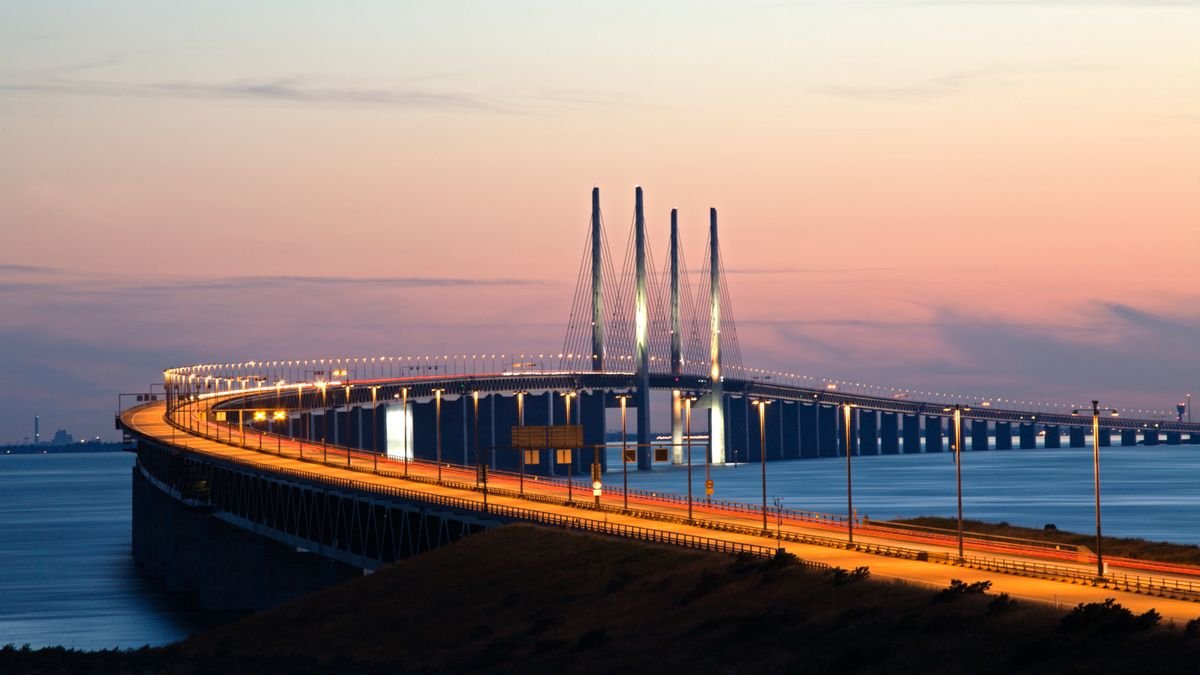

A remarkable feat of engineering allows travelers to experience both Denmark and Sweden in a single day through a unique ‘disappearing bridge.’ Known as Øresund in Danish and Öresund in Swedish, this structure starts as a bridge and seamlessly transitions into an underwater tunnel, giving the illusion of vanishing beneath the water surface.
Connecting the vibrant cities of Copenhagen and Malmö, the Øresund Bridge is the second longest in Europe after the Kerch Bridge in Crimea. Serving as a symbol of unity and cooperation between nations, it played a prominent role in the Eurovision Song Contest held in Malmö in 2013.
Comprising an 8km bridge, a 4km underwater tunnel acting as an artificial reef, and a 4km manmade island called Peberholm, the Øresund link sees an average daily footfall of 70,000 individuals. Built over five years at a cost of £2.3 billion (£4.8 billion in today’s money), the project also includes a unique tunnel design to prevent radio signal interference with Copenhagen Airport.
Operated by Swedish company Svedab and Danish firm A/S, Øresundsforbindelsen features a motorway exit for authorized vehicles and a helicopter pad for emergencies. Crossing fees vary based on transport mode, with costs ranging from £25.68 for motorcyclists to £178.55 for vans and trailers.
Celebrated for its economic impact and role in creating a trading region of over 4.2 million people, Øresund has been a pivotal success story benefiting both Denmark and Sweden. Recognized with the IABSE Outstanding Structure Award, the bridge also gained fame as a key location in the TV crime drama series “The Bridge.”