

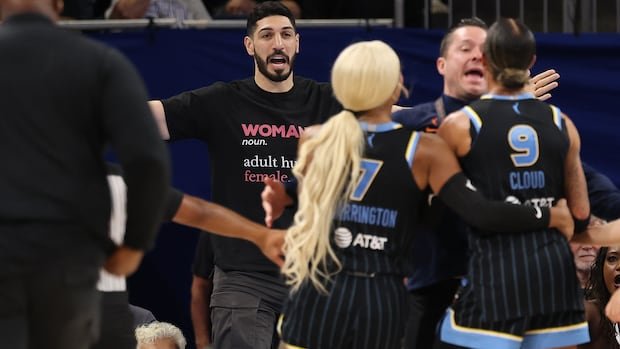

On Sunday evening, the Chicago Sky and the Indiana Fever clashed in a competitive game at Wintrust Arena, with the Fever securing a 113-90 victory, led by Caitlin Clark. The attention surrounding this game extends beyond women’s basketball excellence to an incident involving former NBA player Enes Kanter Freedom, who engaged in a verbal dispute with the Sky’s Natasha Cloud near the court’s baseline, resulting in his ejection from the venue.
Kanter, known for his outspoken views, inserted himself into a discussion about transgender women in the WNBA, despite the absence of transgender players in the league. Wearing a t-shirt that stated “Woman 🔊noun. Adult human female,” Kanter attempted to make a statement on biological females, positioning himself as an authority on the matter.
Natasha Cloud, a prominent player recognized for her social justice advocacy, expressed concern that the altercation could have distracted the team, a sentiment later dismissed by head coach Tyler Marsh. Marsh reassured Cloud of her integral role in defending the team and its values.
Kanter Freedom’s actions, seemingly aimed at generating public pressure and social media attention, reflect his self-appointed role as a guardian of women’s sports, despite lacking a genuine connection to or understanding of women’s athletics. His recent stunt of declaring himself eligible for the 2027 WNBA draft, along with another player, Royce White, underlines his controversial approach.
The WNBA’s current rules stipulate that only biological women are eligible to compete in the league, without specific guidelines regarding transgender or DSD athletes’ eligibility. Following the incident at Wintrust Arena, it was clarified that Kanter Freedom would not meet the criteria for WNBA eligibility, rendering his actions at the game as provocative and calculated.
The presence of Sophie Cunningham, known for her stance against the inclusion of transgender women in sports, during Kanter’s confrontation with Cloud further fueled the narrative of anti-inclusion sentiments within the women’s sports community. Such incidents highlight the ongoing challenges faced by women athletes in navigating discussions on gender identity and inclusion in sports.
The controversy surrounding Kanter Freedom’s actions underscores the broader societal debates on inclusivity and representation in sports, with critics questioning the motives behind his involvement in women’s sports discourse. As advocates continue to champion equality and support for women athletes, the need to counter harmful narratives and promote inclusivity remains paramount in shaping a more equitable sports landscape.