

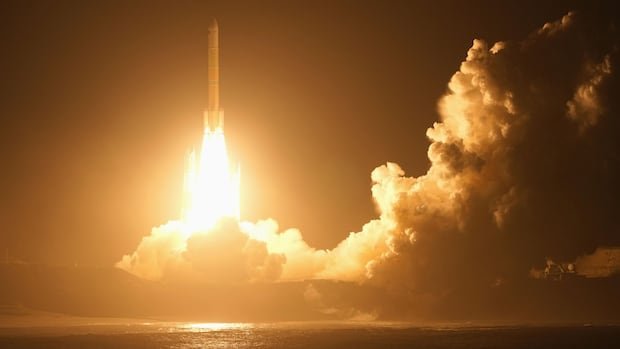

A spacecraft from Japan was launched on Tuesday with the goal of exploring the moons of Mars and bringing back samples. This mission, involving five space agencies worldwide, aims to land a robotic prospector and a rover on Phobos, the larger of Mars’s two moons.
The spacecraft, led by the Japan Aerospace Exploration Agency, was launched from Tanegashima Island’s main spaceport. The successful separation of the spacecraft from the rocket’s upper stage was confirmed an hour later, prompting celebrations among flight controllers.
While NASA and China have landed spacecraft on Mars previously, no mission has ever explored Phobos or its companion moon Deimos, nor brought back samples from Mars or its moons. If successful, samples from Phobos are expected to reach Earth by 2031.
Japan holds an advantage in this mission due to its experience with asteroid sample returns. The mission, named MMX (Martian Moons Exploration), is a $812 million endeavor featuring a five-ton spacecraft that is set to reach Mars by late summer. The spacecraft will rendezvous with Phobos and deploy a French-German rover named Idefix.
Idefix, no larger than a microwave oven, will land on Phobos and serve as a scout for safety, exploring the moon for 100 days. The four-wheeled rover is designed to self-right if it lands upside down, but precautions are in place to avoid potential hazards.
The mission involves drilling and vacuuming at least 10 grams of material from Phobos before returning to Earth in 2031. Scientists hope to uncover clues about the formation of Mars’s moons, shedding light on planetary and moon formation processes.
The findings from this mission are anticipated to influence future Mars missions and contribute to understanding the potential for life beyond Earth. Japan’s investment in the mission, along with contributions from NASA, the French and German Space Agencies, and the European Space Agency, underscores the collaborative effort in exploring the mysteries of the Martian system. China also has plans for a sample return mission to Mars, aiming for a similar timeline in 2031.