
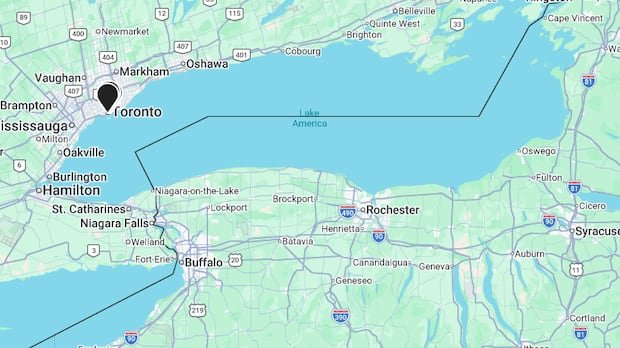

Several Canadian websites, including those of the federal government, exhibited maps where Lake Ontario was labeled as Lake America on Sunday, following Google Maps’ adjustment to comply with a directive from U.S. President Donald Trump. Google announced the change on Saturday, stating that it was based on the U.S. government’s official database renaming the lake.
While Google indicated that the alteration would impact only U.S. users, several Ontario and Canadian websites showed Lake America on their maps. These included Hydro One’s outage map, the Liquor Control Board of Ontario (LCBO) store locator, GO Transit’s station finder, and the federal government’s housing and infrastructure map. Hydro One acknowledged the error, attributing it to a third-party mapping service.
Metrolinx, the agency owning GO Transit, confirmed awareness of the issue and stated they were reviewing their websites to ensure accurate identification of Lake Ontario. By late Sunday afternoon, corrective actions had been taken, with the GO Transit map disabled and the LCBO map reverted to displaying Lake Ontario.
Google clarified that website developers embedding Google Maps could localize the map by selecting a specific region, thereby determining the displayed place names. This region setting ensures that “Lake Ontario” appears for users in Canada.
Tech analyst Carmi Levy explained that Canadian websites, powered by Google’s API, inadvertently displayed Lake America due to the API’s lack of location awareness. Levy emphasized the importance for developers to select Canada as the region to localize maps properly.
Ontario Premier Doug Ford criticized the name change, affirming that Lake Ontario’s historical identity would persist. Trump’s attempt to rename the lake sparked tensions between the U.S. and Canada amid escalating trade disputes. Ford advocated for a return to discussions for a mutually beneficial trade agreement.
Trump’s previous executive order to rename the Gulf of Mexico to the Gulf of America had similar repercussions on online mapping services. Levy highlighted the parallels between the Gulf of Mexico and Lake Ontario naming confusion, emphasizing the complexities involved in implementing such changes across various platforms.