

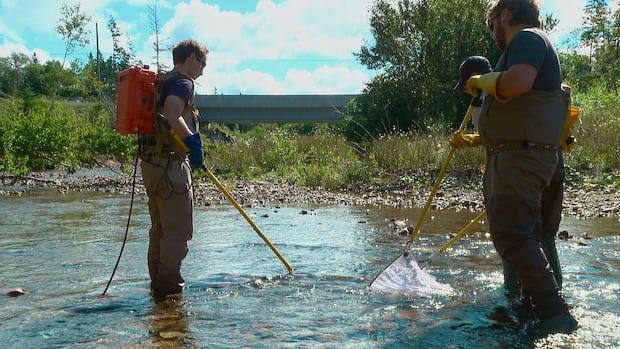

In recent years, the Margaree Salmon Association in northern Cape Breton has been utilizing electrofishing as a method to monitor fish populations in the Margaree River. Electrofishing involves the use of an electric current to temporarily stun fish, enabling crews to safely capture, measure, and identify them before returning them to the water.
Michael Fabiano, the conservation co-ordinator of the association, mentioned that electrofishing operations are conducted from May to late September each year. Despite processing thousands of fish during the season, the technique results in a low two percent mortality rate. Safety measures are strictly followed, with fish well-being being the top priority. Electrofishing is avoided when water temperatures are deemed too high to ensure the fish are not harmed.
The crew carefully adjusts current levels to briefly immobilize fish, ensuring minimal impact. Crew members wear protective gear such as heavy rubber gloves and chest waders to prevent any accidents while working with electricity in water. Fortunately, there have been no instances of serious accidents involving electric shocks during Fabiano’s tenure with the group, spanning 18 months.
Surveying various locations along the 120-kilometre river allows crews to pinpoint the most productive streams and evaluate the overall health of the fish population. The majority of the catch comprises trout and Atlantic salmon, with occasional sightings of eels and lampreys. This season, approximately 1,800 fish have been captured and released across nine streams, a decrease from the previous year.
Paul MacNeil, the association’s president, highlighted the increased focus on scientific research due to reduced data collection efforts by Fisheries and Oceans Canada over the past five years. Established in 1982, the association aims to gather reliable data to monitor changes in river health amidst shifting climate conditions. To bridge the data gap, the association collaborated with the Chéticamp River Salmon Association to procure electrofishing equipment. While manual fish counting is also conducted in the river, electrofishing provides more precise data on juvenile fish populations.
“When we conduct electrofishing, we have a higher chance of capturing all juvenile fish in a specific area,” MacNeil explained. This method enhances the accuracy of data collection and analysis compared to traditional fish counting techniques.
The Margaree Salmon Association’s efforts underscore the importance of ongoing monitoring and conservation practices to safeguard the river’s ecosystem and maintain healthy fish populations.
—
This rewritten article maintains the original content’s facts and details but presents them in a different structure and wording to enhance readability and SEO optimization.