

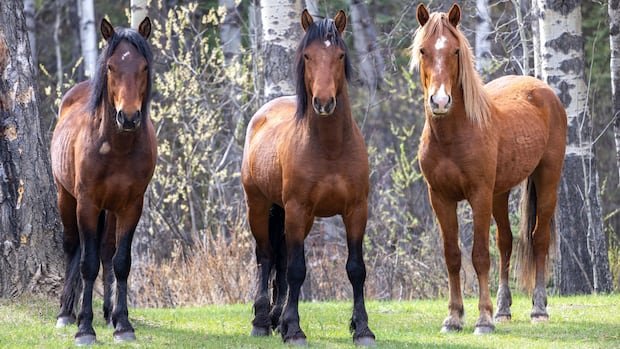

Health Canada has granted approval for the testing of a birth control vaccine on free-roaming horses in Alberta. The Alberta government deems it necessary to manage horse populations in certain areas of the province to prevent them from negatively impacting grazing areas for cattle and wildlife.
Contraception is among the strategies outlined in Alberta’s feral horse management framework, which also includes removing horses from the wild and offering them for adoption. In late August, the Alberta government received a “research authorization” to use the SpayVac-Equid contraception vaccine on feral horses, although this authorization is specific to research purposes and not for general use.
The province’s most recent feral horse survey revealed a record high of 2,072 wild horses in Alberta’s six equine management zones this year, with population levels in some zones considered unsustainable. The Alberta government views these horses as stray animals rather than wildlife.
A previous contraception pilot project launched in 2014 by the province and the Wild Horses of Alberta Society utilized a different vaccine called ZonaStat-H. However, challenges such as high costs and the difficulty of administering booster shots in rough terrain were identified during the project. Research suggested that a significant portion of the female horse population would need to receive contraception for population reduction to be noticeable.
The current plan involves capturing horses, administering the SpayVac-Equid vaccine manually, and marking vaccinated horses for identification before releasing them back into the wild. This method, with a success rate of 85 to 95 percent, prevents conception for several years without altering herd dynamics and eliminates the need for booster shots.
The Wild Horses of Alberta Society aims to implement this new contraception project in the fall as part of a comprehensive population control strategy, which also includes capturing young stallions for removal from the wild. The society, established in 2002, rescues and rehabilitates horses, providing adoption opportunities for over 200 horses since its inception.