

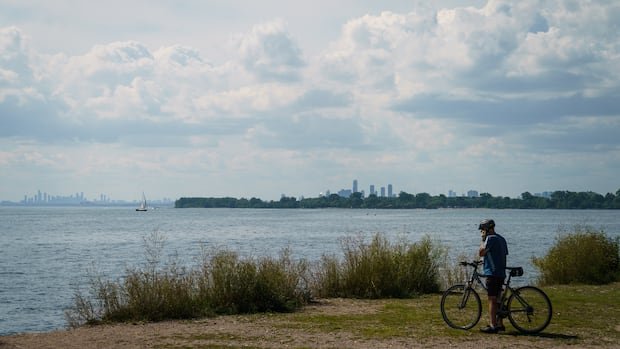

The Great Lakes, a significant reservoir of freshwater and a vital water source for around 40 million individuals, have historically represented the close connection between Canada and the U.S.
On Thursday, in the midst of his trade dispute with Canada, U.S. President Donald Trump made a bold move by signing an executive order to rename Lake Ontario as Lake America. This action raises questions about Trump’s authority to unilaterally change the lake’s name, a name that has been recognized internationally for centuries.
The executive order is part of a larger strategy by the Trump administration that has impeded collaborative efforts between the U.S. and Canada on scientific research and environmental restoration projects in the Great Lakes region.
Aaron Fisk, a professor at the University of Windsor’s Great Lakes Institute for Environmental Research, expressed concern over the U.S. administration’s shift away from evidence-based environmental decisions, emphasizing the importance of American leadership in scientific endeavors.
The Trump administration’s substantial reductions in federal public service funding have had a direct impact on crucial U.S. scientific agencies like the National Oceanic and Atmospheric Administration and the Environmental Protection Agency, affecting monitoring and research activities in the Great Lakes.
Joel Brammeier, CEO of the Alliance for the Great Lakes, emphasized the necessity of U.S.-Canada cooperation in managing and preserving the shared waters of the Great Lakes, highlighting the transboundary nature of water management.
Despite the budget cuts, bipartisan support has rallied behind the Great Lakes Restoration Initiative, a long-standing program aimed at ecological restoration and pollution mitigation in the region. The program, initially threatened with elimination, received approval for continued funding through 2031 with bipartisan backing in the U.S. House of Representatives.
Industrial development in both the U.S. and Canada has historically centered around the Great Lakes region, with sectors such as steel, chemical, and aluminum manufacturing leaving a legacy of environmental contamination that demands remediation.
Climate change presents new challenges for the Great Lakes, including extreme weather patterns and shifting precipitation, necessitating coordinated research efforts on both sides of the border to address emerging threats.
Amid concerns about future water demand and usage in the region, efforts are underway to safeguard the Great Lakes Compact and Agreement, governing water usage among U.S. Great Lakes states, Ontario, and Quebec. The need to anticipate and manage external pressures on Great Lakes water resources remains a critical issue for the future.