

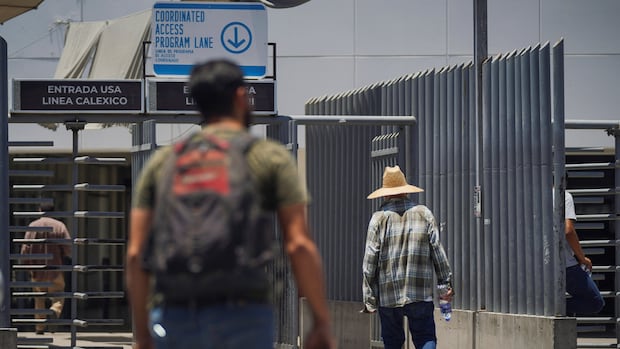

Last week, the U.S. Supreme Court decided to take on a pivotal case related to the immigration policy of the Trump administration, focusing on the circumstances under which migrants may apply for asylum.
Although this announcement was somewhat overshadowed by an unexpected halt of air travel in the U.S. on a Friday afternoon, it signifies that the Supreme Court will now review at least three significant immigration cases during its session, which extends until June 2027.
According to SCOTUSblog, which monitors the activities of the Supreme Court, the Trump administration’s “reinterpretation of specific detention and deportation regulations” has resulted in “a notably elevated number of immigration cases” compared to earlier sessions. The blog also noted several additional cases that, while having a narrower impact, could still be linked to immigration issues in an October entry.
During the 2025-2026 session, the Supreme Court dismissed a Trump administration attempt to terminate birthright citizenship for future cases but issued a significant ruling that facilitated the federal government’s ability to deport many Haitian Americans and other long-term residents who had escaped natural disasters or chaos in their native countries.
These new cases have the potential to lead to Supreme Court decisions that could significantly alter the U.S. immigration and asylum framework or at least clarify actions taken during President Donald Trump’s second term, some of which are highly contentious.
Here’s a summary of the three key cases currently on the 2026-2027 docket:
Presidential power to restrict asylum
U.S. legislation, particularly the Immigration and Nationality Act (INA), has generally upheld the rights of migrants to file for asylum upon arriving at a border checkpoint or even if they are apprehended while attempting to enter the country at unauthorized locations. Historically, the number of asylum denials has often exceeded the approvals, though this ratio has varied over the years.
In his last year in office, former president Joe Biden aimed to address the rising influx of arrivals at the southern border by promoting appointment-based asylum claims through a temporary executive order that restricted asylum eligibility based on the number of daily encounters at the border.
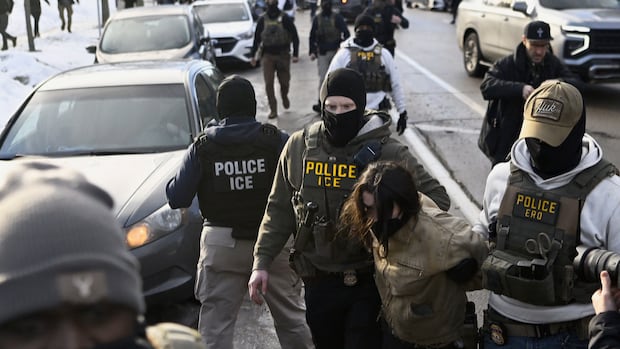
U.S. Immigration and Customs Enforcement (ICE) has become a pivotal component in President Donald Trump’s strategy to deport millions of undocumented immigrants, though as CBC’s Jonathan Montpetit explains, that was not its original purpose.
On the first day of his second presidential term in 2025, Trump enacted an executive order that he deemed essential due to an “invasion” occurring at the southern border.
Essentially, Trump’s order has created a near-complete asylum ban for migrants intercepted while crossing between official border points. This ban also affects those who arrive at legal crossings but do not meet specific medical or criminal requirements, a stipulation that advocates argue is often unachievable for individuals escaping violence.
Initially blocked by a federal judge, the order was subsequently upheld in April by the U.S. Court of Appeals in D.C., which ruled 2-1 that the INA does not “allow the president to remove [migrants] under summary removal procedures of his own making.”
In a partial dissent, Judge Justin Walker noted that while the administration has the authority to broadly reject asylum applications, the INA and other regulations prohibit returning individuals to countries where they would face persecution.
-
On immigration, Trump administration has tallied more victories than losses
-
Trump appoints Miller, a key architect of U.S. deportation policies, as new chief of staff
The extent to which this has been applied to asylum claims the government does process is debatable. Denial rates for some cases have reportedly exceeded 90 percent, as per the Transactional Records Access Clearinghouse at Syracuse University. Such high denial rates have not been witnessed for decades, if ever.
Democratic House Representative Rob Menendez from New Jersey commented on Friday after the Supreme Court’s decision to take on the case, stating that “repairing our fractured immigration system necessitates honoring our values as a nation of immigrants” while “safeguarding the right to apply for asylum.”
Deportations to third countries
The Supreme Court justices will convene to hear oral arguments on December 9 regarding a contentious element of the Trump administration’s deportation policies, which is also tied to executive orders signed by the president on his first day back in the Oval Office in 2025.
Traditionally, the U.S. has adhered to the principle of non-refoulement, meaning that individuals should not be returned to countries where they could reasonably expect to face persecution or torture based on race, religion, sexual orientation, political beliefs, or other criteria.

Deportees from the U.S., all citizens of third countries, arrive at Juan Santamaria International Airport, near Alajuela, Costa Rica, on April 11 under an agreement to accept such deportees. (Mayela Lopez/Reuters)
However, through the Trump executive orders, the administration has attempted to implement third-country deportations. A website created by two human rights organizations indicates that the Trump administration has allocated over $95 million to deport more than 28,000 individuals to 31 different nations and has formed agreements to potentially deport individuals to four additional countries.
In numerous instances, individuals are sent to nations with which they have no prior connections. Additionally, several of the countries that have agreements with the U.S. have a questionable history regarding the protection of human rights and personal freedoms.
-
U.S. Supreme Court allows Trump to proceed with deportations to third countries — for now
-
Liberia to begin accepting up to 1,200 deportees from the U.S.
According to a statement from the UN’s Human Rights Council earlier this year, “These migrants are being transferred to countries or territories with which they have no ties, resulting in a distressing and isolating experience that exacerbates the traumas they have already endured, which led them to flee to the U.S. in the first place.”
The Trump administration contends that it has established agreements with other governments where the safety of the deportees is guaranteed. However, the New York Times reported last week that an extensive investigation uncovered 110 individuals who were deported to a third nation but then returned to their original home countries, despite U.S. court rulings affirming their legitimate fears in leaving those nations to seek asylum.

Bond hearing access
Historically, individuals without a criminal record who were arrested in the U.S. away from border checkpoints were typically granted the chance to request a bond hearing. This procedure often allowed them to work and remain free while awaiting the outcome of their immigration court cases, which would ultimately determine their deportation status.
The Trump administration has terminated this practice, citing an interpretation of legislation from 1996. Following conflicting rulings in federal courts nationwide, the Supreme Court will address this matter after the American Civil Liberties Union initiated a lawsuit on behalf of Ricardo Aparecido Barbosa da Cunha.
-
Canadian dentist detained by ICE in Minnesota released after federal court ruling
-
CBC Investigates
Winnipeg-born man deported back to Canada after 9 months in ICE detention
The Brazilian individual entered the U.S. unlawfully two decades ago and, according to his legal representatives, has not faced any charges or convictions. Despite this, after being detained by federal immigration agents while heading to work in September 2025, an immigration judge ultimately denied him a bond hearing.
Data from the Deportation Data Project at UC Berkeley and UCLA reveals that the number of detention beds available for individuals arrested within the U.S. has more than quadrupled over the last two years, indicating significant stakes in this case.
Similar to the asylum case announced last Friday, a date for oral arguments has not yet been established.