

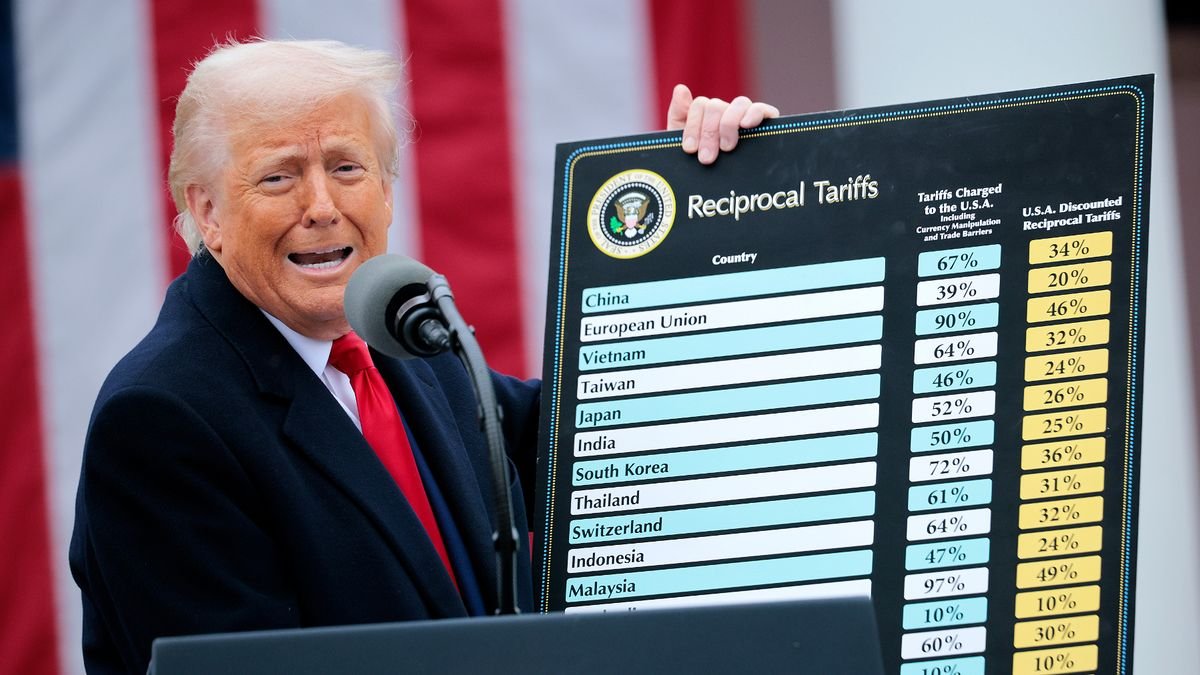

President Donald Trump issued a stark warning, stating that if the Supreme Court deemed his tariffs unlawful, it would have catastrophic consequences for the United States. Recent developments have shed light on the outcome of this warning.
Reflecting back to a significant event approximately six months ago at the White House Rose Garden, where President Trump imposed tariffs on all nations worldwide, including remote islands inhabited solely by penguins. Following an extensive legal battle, the highest court in the US has ruled that these actions were unconstitutional, emphasizing that tariffs must be authorized by Congress under the US Constitution.
President Trump attempted to circumvent this requirement by invoking an old “emergency” law, asserting it granted him the authority to implement tariffs independently without congressional approval. This approach was crucial for his policy agenda, ranging from financial strategies to international relations, all heavily reliant on his ability to levy tariffs on foreign countries.
The threat of imposing tariffs at his discretion, often communicated through social media, enabled President Trump to coerce nations into complying with his demands. Alleged diplomatic successes, such as ending conflicts, were purportedly achieved through the fear of facing substantial tariffs from the US.
However, the Supreme Court’s ruling has rendered these actions illegal, prompting speculation on the next steps. President Trump’s administration is likely to seek alternative avenues, though legal experts believe the ruling is comprehensive and resistant to circumvention.
Should President Trump fail to find an alternative strategy, various companies, including Costco, Chinese automaker BYD, and camera manufacturer GoPro, are poised to seek refunds from the federal government for the import duties paid over the past half-year, potentially totaling billions of dollars.
Consequently, the ruling has inflicted two notable setbacks on President Trump. Firstly, he has lost a crucial tool for pressuring other nations into compliance, as the threat of moderate tariffs for a limited duration lacks the impact of permanent, substantial tariffs. Secondly, this marks the first significant rejection by the Supreme Court against President Trump, underscoring the limitations of his authority even with a conservative-leaning court.
The implications of this ruling are significant, signaling a shift in the balance of power and accountability within the US government.