

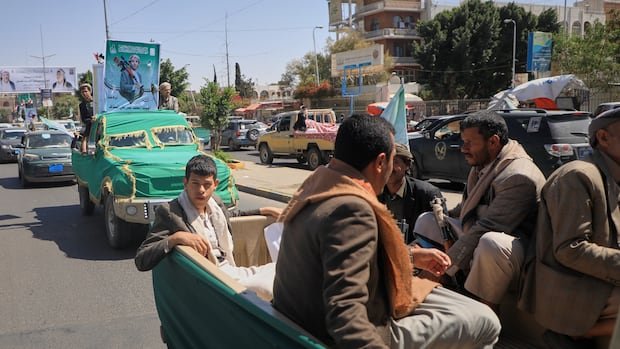

Saudi warplanes launched airstrikes on Yemen while Houthi fighters retaliated with drones and missiles targeting Saudi cities, as reported by the Iran-backed group on Wednesday. This escalation has expanded Iran’s influence in the ongoing conflict in the Middle East.
The United States heightened its travel advisory for Saudi Arabia, prohibiting government personnel from traveling within 32 kilometers of the Yemeni border, underscoring the intensifying situation. The Houthis, who have recently made significant territorial gains in Yemen, shared video footage showing their fighters seizing armored vehicles from Saudi-backed forces amidst airstrikes and explosions in the desert.
Houthi military spokesperson Yahya Saree disclosed that the group conducted drone and missile strikes on the Saudi Red Sea oil port of Yanbu and a southern Saudi airbase at Khamis Mushait. Although the timing of these attacks was not specified, these locations were part of the heightened alert issued by Saudi Arabia on Tuesday.
Saudi authorities and oil company Aramco did not immediately respond to requests for comments on these recent developments. Saree also claimed that the Houthis shot down a Saudi F-15 fighter jet, although no concrete evidence was presented to support this claim.
Moreover, sources revealed that U.S. officials engaged in discussions with the Houthis in Oman over the weekend, where the group reaffirmed its commitment to a ceasefire agreement reached with the U.S. last year, emphasizing they had no intentions of targeting American vessels.
The conflict spilling into Yemen raises concerns about exacerbating the global energy supply shortage caused by the prolonged U.S.-Israeli conflict with Iran, disrupting oil shipments through the Strait of Hormuz. The potential impact on oil prices was reflected in Brent crude hovering around $108 a barrel, nearing its highest level since May. The U.S. also faced record-high average retail diesel fuel prices above $6.30 a gallon.
Traders warned that a prolonged closure of Saudi Arabia’s East-West pipeline could disrupt up to four percent of global oil supply. While Saudi Arabia has not specified when operations might resume, U.S. Energy Secretary Chris Wright indicated that oil flow through the pipeline could resume within days.
The conflict between Saudi-led forces and the Houthis, ongoing since 2015, had previously subsided under a ceasefire before reigniting over recent provocations and clashes. The Crown Prince of Saudi Arabia sought military support from the U.S., primarily in the form of intelligence assistance, amidst the escalating violence.
The dilemma facing U.S. President Donald Trump lies in deciding whether to intervene more directly to support Saudi Arabia against the Houthi advancement, risking a broader military entanglement, or maintain a cautious stance amid the escalating global energy crisis.