

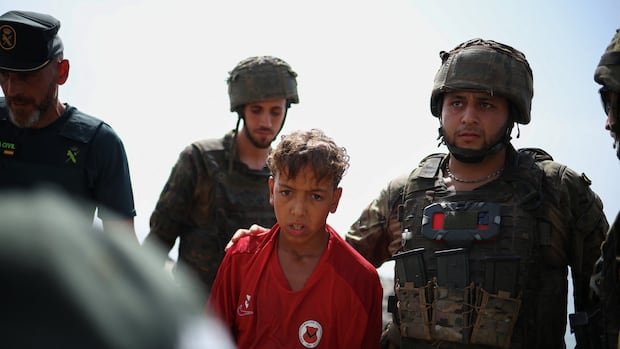

In Ceuta, a small Spanish territory located at the northern tip of Africa, more than 72,000 individuals made their way from Morocco last week by swimming around the border. Asylum seekers in Ceuta are currently in a state of uncertainty, awaiting information on what will happen next.
This week, numerous individuals were observed resting on a small beach on the outskirts of the town. The few available shelters in the enclave were mostly occupied by women and children. Aid organizations, initially absent when exhausted swimmers arrived, are now providing food and water to those who were not turned back to Morocco due to an agreement designating Morocco as a safe third country, preventing Moroccan nationals from seeking asylum in Spain.
While humanitarian groups are addressing the immediate aftermath on the ground, the focus across Europe has shifted to discussions on how to prevent similar mass crossings in the future. European lawmakers convened in Brussels to debate the events in Ceuta and migration policies following one of the bloc’s most contentious political disputes on migration in recent years.
In response to the crossings, European Union member states quickly pointed fingers at Spain, accusing Prime Minister Pedro Sánchez’s government of encouraging migrants to attempt the journey. Italy temporarily suspended passport-free Schengen travel arrangements with Spain, despite these arrangements not applying to Ceuta. Additionally, 22 out of the 27 EU member states called for reinforced external border controls.
European Commission President Ursula Von der Leyen condemned the crossings as “unacceptable,” while German Chancellor Friedrich Merz urged Morocco to promptly repatriate illegal migrants. The recent meeting saw interior ministers expressing solidarity with Spain and denouncing attempts to divide the EU.
The discussions surrounding Ceuta have been shaped by varying opinions on migration policy and domestic political considerations. Davide Colombi, a migration researcher, noted that member states’ governments are prioritizing their national interests rather than European unity, with blame being directed at Spain for the events in Ceuta.
The discourse on Ceuta has predominantly framed the crossings as a security threat rather than a humanitarian crisis. This narrative shift has been a point of concern for many, with politicians across Europe adopting language that portrays the situation as an “invasion.”
Spain’s approach to migration has diverged from that of other European countries, with Prime Minister Sánchez implementing programs to regularize the status of undocumented migrants already residing in Spain. In contrast, countries like Italy, Denmark, and the Netherlands have emphasized migrant returns and stricter border controls.
The reasons behind the mass attempts to cross into Ceuta last week remain disputed, with misleading online claims, a recent Spanish Supreme Court ruling, and questions about Morocco’s border enforcement being cited as contributing factors. Misinformation spread online, suggesting that those reaching Ceuta would be allowed to stay in Spain, while videos falsely claimed Spain’s regularization program was ending, creating urgency among migrants.
As European leaders focus on reinforcing borders, the plight of thousands of asylum seekers in Ceuta awaiting legal assistance, shelter, or asylum decisions has taken a backseat. Many individuals, including 1,100 unaccompanied minors, remain in uncertainty, lacking basic necessities and awaiting clarity on their futures.