

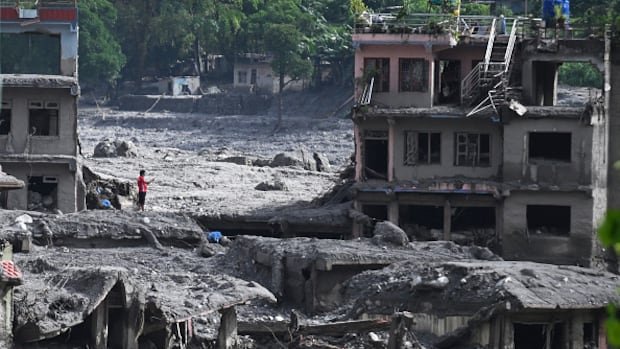

Rescue teams, accompanied by search dogs, are tirelessly combing through mud, rocks, and debris along the Nepal-China border in search of thousands of missing individuals in the aftermath of devastating floods that ravaged communities across the Himalayas, resulting in over 1,000 fatalities.
In Kathmandu, police are conducting burials for numerous bodies in multiple trenches, while Nepal’s disaster agency has confirmed 1,003 deaths and 3,916 individuals missing, which includes 583 foreign nationals. China has reported 16 deaths and 546 missing persons, including 261 foreigners in its most recent update.
The massive scale of the disaster on August 26 is impeding rescue operations in both countries due to landslides, destroyed infrastructure, and extensive damage that have isolated remote regions. Rescue crews are facing challenging conditions as they navigate unstable terrain and heaps of debris, heightening concerns that the death toll may escalate as they reach isolated communities.
Efforts are underway to rescue hundreds of workers believed to be trapped in tunnels at hydropower facilities in Nepal that were damaged by the floods. Approximately 900 workers are unaccounted for across 12 projects, with an estimated 500 trapped in tunnels, as per local authorities.
Nepal’s army spokesperson, Brig. Gen. Raja Ram Basnet, stated that teams, including foreign experts, are engaged in rescue operations at various hydropower projects. Images released by the army depict rescue teams navigating debris-filled tunnels and wading through mud and water in their search for survivors.
Meanwhile, rescue crews on the Chinese side are scouring areas impacted by mudslides, particularly in the vicinity of the destroyed Gyirong Port border crossing. Some teams are employing heavy machinery to clear a major highway leading to Gyirong Port, aiming to facilitate the passage of equipment, personnel, and supplies into the disaster-stricken zone.
In Kathmandu, amidst heavy rainfall, police are burying bodies in designated trenches adjacent to a wooded area. The site is secured with barbed wire, while graves are marked with blue numbered identifiers for unidentified individuals.
Nepalese authorities are interring bodies in temporary graves until they can be identified, preserving DNA samples, documenting distinguishing facial features, and assigning reference numbers to facilitate future identification and claims by families.
Relief operations are expanding to reach stranded communities, with over 11,800 individuals rescued thus far. Emergency teams are utilizing helicopters and aircraft to access isolated areas where infrastructure has been destroyed by flooding and landslides.
Foreign Affairs Minister Anita Anand announced that the Canadian government is providing $5 million in emergency aid to Nepal, with additional support earmarked for reconstruction efforts. Canada has dispatched a team, including an RCMP officer and the deputy high commissioner to India, to assist in the response.
China’s Foreign Ministry spokesperson, Guo Jiakun, revealed plans to send a second batch of relief supplies to Nepal, including drones, DNA testing kits, and water purification equipment, along with Chinese DNA testing experts to aid in identifying bodies.
The catastrophe in the Himalayas originated from a glacial collapse that released a torrent of rock, ice, and meltwater into valleys below, triggering destructive floods downstream. Scientists analyzing satellite data suggest that the collapse involved the failure of bedrock beneath a glacier, registering as a seismic event of magnitude 5.2.
Nepal’s Prime Minister Balendra Shah emphasized the urgency of addressing climate change, citing the disaster as a stark reminder of escalating risks in the Himalayan region. He urged vigilance and global action on climate-related disasters.