

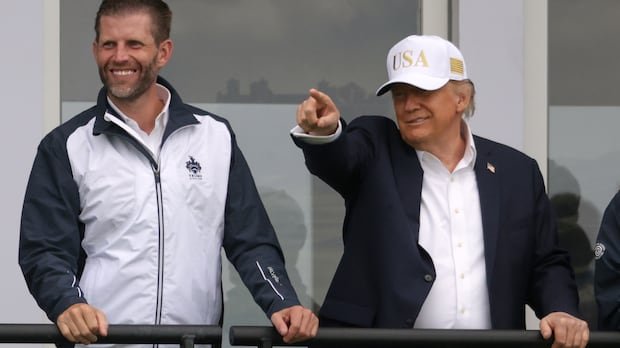

President Donald Trump criticized opponents of artificial intelligence (AI) on Sunday, labeling them as pessimistic and raising unfounded concerns. Trump emphasized the need for the United States to maintain its position as a leader in AI, stating that the country is ahead of China in this field. He dismissed the idea of slowing down AI progress or imposing more regulations, suggesting that certain negative forces are exaggerating potential issues that are unlikely to materialize.
The topic of AI is expected to be on the agenda when Chinese President Xi Jinping visits the White House later this month to meet with Trump. During his recent visit to Ireland, Trump engaged in discussions with President Catherine Connolly and Prime Minister Micheál Martin before attending the Irish Open tournament at his golf course.
When questioned about the risks associated with AI, Trump asserted that he is not downplaying the concerns and believes that the benefits of AI will outweigh any drawbacks. He reiterated the significance of winning the AI race, emphasizing its importance for the future.
The public discourse surrounding AI has intensified following warnings from researchers at Anthropic, a safety and research company, who suggested that the rapid advancement of AI could pose existential threats to humanity. Despite these concerns, Trump’s administration has largely embraced AI companies, with industry leaders supporting his initiatives.
As the U.S. gears up for the upcoming election, AI has emerged as a key issue, with major companies expanding their computing infrastructure across rural areas. Trump’s backing of data centers contrasts with the apprehension expressed by both Republicans and Democrats over potential environmental and societal impacts.
Former President Barack Obama has urged his party to address AI in their campaign strategies, emphasizing the need to consider the economic implications and job displacement risks associated with AI deployment. Meanwhile, AI executives have been actively involved in funding the midterm elections, with SpaceX CEO Elon Musk’s political action committee playing a significant role in supporting Republican candidates.
Amidst the growing concerns, Anthropic CEO Dario Amodei proposed a framework to regulate AI development, garnering support from industry executives, including Musk and OpenAI CEO Sam Altman. Amodei highlighted the challenge of balancing the advancement of AI technology while managing associated risks, particularly in the context of the competitive landscape between the U.S. and China.
Jacob Coxon, one of the researchers at Anthropic, emphasized the need for international collaboration to address the pace of AI development and mitigate potential risks. The debate over AI regulation and safety measures continues to evolve, with stakeholders navigating the complexities of advancing technology while safeguarding against unintended consequences.