

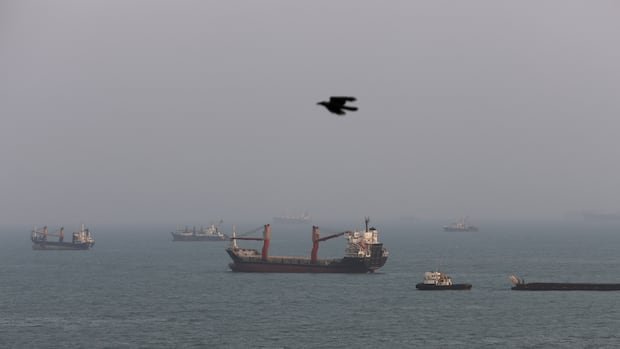

U.S. President Donald Trump declared on Tuesday that there were no ongoing discussions with Iran and affirmed that the Strait of Hormuz was open for shipping, contradicting Iran’s claim that the waterway remained closed. The fading hopes for a resolution to the nearly six-month-long conflict led to a rise in oil prices, while stock markets fell and borrowing costs for major economies, including the U.S., reached multi-decade highs due to concerns about long-term inflationary effects.
After a temporary ceasefire agreement expired on Monday, a senior Iranian official indicated that Iran was transitioning to a “fully offensive” military stance due to the diplomatic impasse. However, there were no new reports of attacks from either side on Tuesday.
Trump stated in a post on Truth Social that there were no ongoing or scheduled talks with Iran, emphasizing that the Naval Blockade was still in place and the Strait of Hormuz was operational with all water mines removed or detonated.
Jared Kushner, Trump’s son-in-law and special envoy, had expressed optimism on Monday, suggesting that talks with Iran were more extensive than ever. The conflict, initiated by joint U.S.-Israeli strikes on Iran, has reached a stalemate, with Iran threatening shipping in the strait and the U.S. warning of potential renewed attacks if negotiations fail to produce a lasting resolution.
One of the primary U.S. objectives is to prevent Iran from acquiring a nuclear weapon, a task made challenging by the presence of enriched uranium reportedly buried at previously targeted sites.
Despite Trump’s positive outlook, reports of attempts to disrupt shipping persisted. The United Arab Emirates reported detecting two ballistic missiles launched from Iran, the first incident of its kind since a strike on Fujairah port in May.
In another development, a vessel transiting the Strait of Hormuz was reportedly struck by an unknown projectile, causing engine room damage and injuring crew members. The Omani Coast Guard provided assistance to the crew, with no immediate response from Tehran.
Iran’s top negotiator, Mohammad Baqer Qalibaf, declared that the strait would remain closed until the U.S. met the conditions outlined in an interim deal signed with Iran in June. The agreement set a 60-day deadline for a broader deal on Iran’s nuclear program and U.S. sanctions, which lapsed on Monday, with Trump indicating no intention to extend it.
While Iran remains open to dialogue with the U.S., officials stress that negotiations should not be mistaken for capitulation. The country asserts that it will defend its security and dignity and uphold its alliances without seeking conflict.
The prolonged conflict has taken a toll, with thousands of casualties primarily in Iran and Lebanon. Iran has carried out attacks on U.S. military installations and infrastructure in various countries. Oil prices have surged during the conflict, with Brent crude futures settling at over $91 per barrel on Tuesday.
U.S. officials have indicated the possibility of escalating economic sanctions on Iran, emphasizing that there are additional measures that could be imposed in the coming months.