

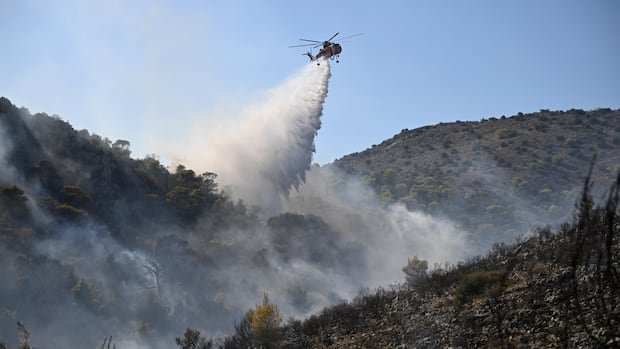

Firefighters have been engaged in combatting a massive wildfire that ravaged a nature reserve in eastern Belgium and another on a Greek island near Athens. The fires, fueled by hot and dry conditions, have caused significant destruction in parts of Europe.
The wildfire in eastern Belgium has consumed approximately 30 square kilometers in the High Fens (Hautes Fagnes), marking one of the most severe wildfires the country has experienced recently. Due to shifting winds and spreading smoke, about 600 residents in the nearby municipalities of Waimes and Bütgenbach in Liège province were evacuated on Saturday. Tourists were also advised to leave the area, with a local gymnasium set up to accommodate evacuees.
Hervé Jamar, the provincial governor of Liège, reported that over 250 emergency personnel, including more than 100 Belgian and German firefighters, as well as police, military officers, and civil protection staff, have been deployed to tackle the blaze. Firefighting helicopters from Belgium’s federal police and the Netherlands have also been assisting in the operation.
In Greece, tragic news emerged with the coast guard confirming the death of an elderly couple on the island of Salamina, located west of Athens, where a fire initially broke out. Over 500 individuals have been rescued from the island, which saw the blaze erupt during the peak summer holiday weekend around the Aug. 15 Assumption holiday. Damage to houses has been reported, with five individuals receiving medical attention at a local clinic.
Efforts to contain the wildfires have seen about 192 firefighters, 14 aircraft and helicopters, volunteer crews, and municipal water tankers mobilized. The coast guard and firefighting vessels have been dispatched to Salamina, with readiness for potential sea evacuations from threatened coastal areas. The island remains under a high wildfire risk warning, with the cause of the fires remaining unknown.
The wildfire in Belgium has broken records, surpassing a 2011 fire that burned nearly 14 square kilometers in the same area. Nicolas Yernaux, a spokesperson for the Public Service of Wallonia, highlighted the challenging conditions, citing extremely dry soil as a significant factor contributing to the intensity of the blaze.
Despite ongoing efforts, the fire in Belgium continues to spread, particularly in areas difficult for firefighting crews to access. Interior Minister Bernard Quintin expressed relief that the blaze has been contained from spreading westward towards the German town of Monschau, with local authorities in Germany cautioning that the fire was approximately 1.5 kilometers from the border.
In response to the escalating crisis, Belgium has activated the European Union’s civil protection mechanism to receive support from other countries. Sweden has dispatched two water-bombing aircraft, while additional helicopters from the Netherlands and the Czech Republic are being deployed to aid in firefighting efforts.
The wildfires sweeping through Europe come after a prolonged period of scorching and arid weather conditions, complicating containment efforts due to the mix of heathland and peat bogs in the affected regions. Belgium experienced another wave of intense heat recently, with temperatures soaring to around 37°C in certain areas.
Meanwhile, in France, authorities reported that firefighters had managed to control a wildfire in a pine forest in the Landes region, with no major flare-ups overnight. Evacuations were carried out, with about 650 individuals displaced from their homes. In the UK, emergency crews tackled 14 wildfires in South Wales, with the assistance of military personnel, amid persisting drought conditions heightening the risk of further blazes.
In Germany, progress was made in containing a wildfire in the Hürtgen Forest, allowing evacuated residents to return home, while in neighboring Gironde, a massive wildfire forced significant evacuations as it advanced towards the Atlantic coast and Bordeaux. The collective efforts of firefighters and support from neighboring countries are crucial in combating the unprecedented wildfires across Europe.