

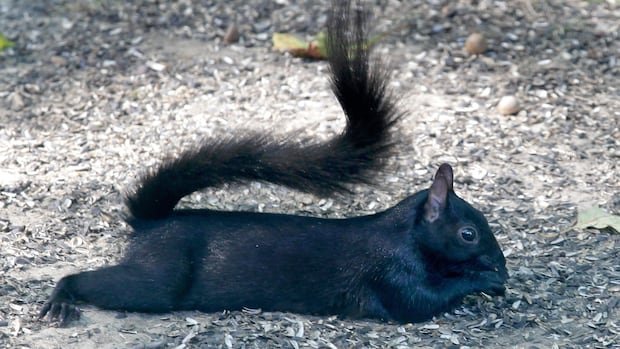

Francis Quang-Hai Dinh spent his first summer at McGill University exploring Montreal’s parks on his bicycle, tracking squirrels. Covering nearly 200 green spaces from Mirabel to Saint-Bruno, he documented over 800 grey and black squirrels. What began as a college assignment evolved into a personal project to understand how the city’s layout and waterways influence evolution.
Dinh developed a fascination with squirrels, viewing them as more than just pests but as integral wildlife. Without access to a car and limited public transport in suburban areas, he relied on his bike to conduct manual surveys of squirrels park by park, a unique approach in the region.
His research revealed that on average, about 12% of Montreal’s squirrels are black, with higher percentages found further north. Areas just north of Laval showed up to 40% black squirrels, while on the island of Laval, it was around 20%. The study attributed this variation to temperature differences, with black squirrels benefiting from their color’s heat-absorbing properties, especially in cooler climates.
Moreover, the density of forest cover played a role in squirrel coat color variation, as black squirrels blend better in darker backgrounds. Allison Roth, the study’s lead author, emphasized that Montreal’s diverse neighborhoods and environmental factors, such as tree cover and waterways like the St. Lawrence River, contribute to unique genetic adaptations among squirrel populations.
The research, focusing on fine-scale spatial variations in squirrel melanism across urban landscapes, challenges the notion that human development solely drives evolutionary changes in city wildlife. It highlights how urbanization impacts local temperatures, vegetation structure, and natural barriers, ultimately influencing squirrel melanism indirectly through these environmental factors.
Published as part of a special feature by ecology journals, the study underscores the importance of understanding urban evolution and its implications for wildlife persistence amid human modifications. Dinh, reflecting on his experience, emphasized the interconnectedness of city and nature, noting that wildlife will adapt and endure despite urban transformations.