

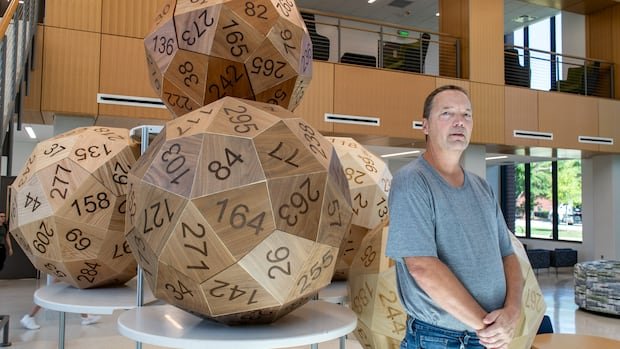

In 2012, Eric Harshbarger, a mathematician and senior lecturer at Auburn University, was challenged by a board game designer to create a set of dice that could determine the starting player without the possibility of a tie. The goal was to expedite the process and allow players to begin their games promptly.
Harshbarger, intrigued by the problem, envisioned a solution where each player could roll a die with an equal chance of winning, ensuring a clear winner without any ties. However, bringing this concept to life with functional dice proved to be a significant challenge.
After nearly 15 years of research and collaboration with a team of experts, Harshbarger successfully developed the Go First Dice for five players. These innovative dice allow for a fair and decisive selection of the starting player with just one roll.
The journey to create these unique dice involved numerous contributors from around the world, with Harshbarger overseeing the project and facilitating the exchange of ideas. While the initial designs for dice accommodating two to four players progressed swiftly, devising a solution for five players presented a more complex puzzle.
Through persistent experimentation and collaboration, the team eventually settled on a set of five 120-sided dice, a breakthrough that attracted attention and further contributions to the project. Canadian software engineer Paul Meyer played a crucial role by proposing a solution using five 60-sided dice, a breakthrough that finally cracked the puzzle after extensive efforts.
The mathematical precision behind the Go First Dice ensures fairness in determining the starting player, with any potential discrepancies likely stemming from the manufacturing process rather than the underlying mathematical principles. As the research continues, the team explores the possibility of refining the design for five-player sets with fewer sides and potentially expanding the concept to accommodate six players.
Despite the challenges and uncertainties encountered along the way, Harshbarger remains fascinated by the problem’s complexity and the collaborative effort required to unravel it. The ongoing research aims to push the boundaries of mathematical and computational possibilities, inviting new perspectives and innovations in the quest for fair and efficient game mechanics.