

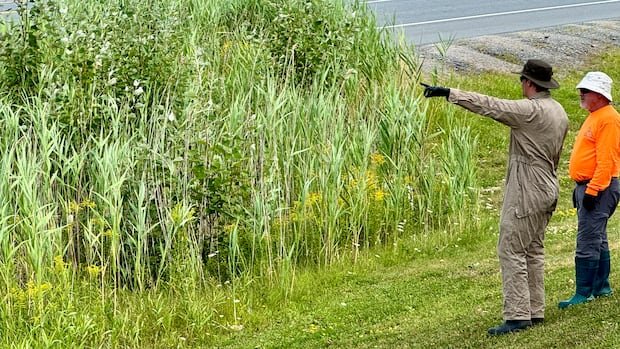

An alien plant is expanding its territory in northern Ontario, prompting local efforts to detect and manage it before it takes root firmly. The Junction Creek Stewardship Committee, an environmental organization in Sudbury, recently conducted a workshop in collaboration with the Invasive Phragmites Control Centre to educate individuals on identifying and preventing the spread of invasive phragmites.
Invasive phragmites, commonly known as common reed, can form dense clusters that displace native flora and disrupt wetland ecosystems. Jayden McGleish, a field supervisor at the Invasive Phragmites Control Centre, noted the plant’s encroachment into northern Ontario, including significant growth in Sudbury.
The invasive plant poses challenges to wildlife as it outcompetes native species like cattails and bulrushes, hindering animals’ movement in their habitats. McGleish observed instances where turtles and frogs struggled to navigate through dense patches, resulting in fatalities.
Moreover, invasive phragmites can encroach on recreational areas, engulfing shorelines and impeding access. The plant’s aggressive growth along roads and even through asphalt can incur municipal costs by disrupting drainage systems and deteriorating road surfaces.
Although more prevalent in southern Ontario, invasive phragmites are increasingly appearing in northern regions such as Sudbury, Sault Ste. Marie, Timmins, and Thunder Bay. Erik Barr from Conservation Sudbury emphasized the importance of controlling the plant early in Sudbury before it becomes unmanageable.
To distinguish invasive phragmites from native varieties, it is crucial to note differences in leaf width, stem thickness, and stem coloration. Educating the public on these distinctions is vital for monitoring and mapping the plant’s spread, especially along transportation routes where accidental dispersal can occur.
Efforts to treat invasive phragmites involve using backpack sprayers and a herbicide called Timberline. Chuck Simpson from the Invasive Phragmites Control Centre highlighted the effectiveness of this method, achieving a high kill rate with the potential for plant regrowth in subsequent years.
Overall, proactive measures to identify, control, and treat invasive phragmites are critical in preserving northern Ontario’s ecosystems and recreational areas. Initiatives like workshops and educational campaigns play a pivotal role in safeguarding the region from the detrimental impacts of this invasive plant species.