

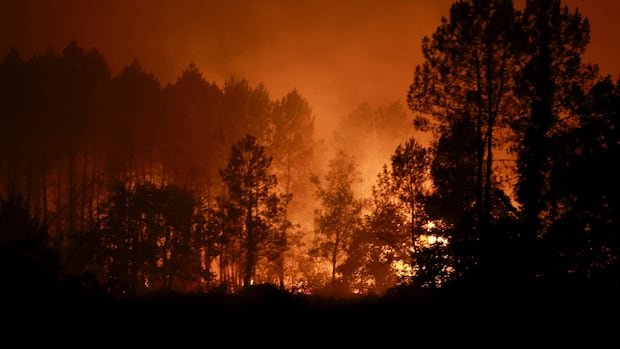

Firefighters in various European countries are battling numerous wildfires amid a new wave of scorching heat, with the ongoing dry conditions adding complexity to their efforts. The exceptionally high temperatures are a direct result of human-induced climate change, impacting nations more accustomed to colder climates and lacking adequate cooling infrastructure.
In France, where this year has seen the driest conditions on record, a fresh wildfire tore through woodlands in the Landes region, prompting over 500 residents in Luglon to evacuate. This is one of several fires raging across different parts of France, even in traditionally cooler and wetter areas like the north and Brittany.
Across the Channel, the United Kingdom experienced its hottest day of the year, leading to fires in the West Midlands that triggered numerous emergency calls and forced evacuations, with 19 people hospitalized. In Stourbridge, a significant blaze destroyed around 20 to 30 homes, leaving many residents homeless.
Meanwhile, in Germany, all 1,800 inhabitants of Gey village were relocated due to a wildfire in the nearby Hurtgen forest, with unexploded ordnance from World War II hampering firefighting efforts. In Croatia, a fire near the coastal town of Omiš forced over 1,000 people to flee their homes, with several hospitalized and significant property damage reported.
In Albania, multiple wildfires are being battled, with the largest in the Gurë-Lurë area, where efforts have contained the flames from reaching residential homes. Greece also faced evacuations as wildfires threatened seaside properties, while Belgium recorded its hottest August 13 on record, with soaring temperatures fueling concerns of severe drought.
France took precautionary measures by shutting down six nuclear reactors due to the extreme weather conditions, with one closure attributed to an influx of jellyfish near a plant on the English Channel Coast. These jellyfish sightings are linked to warm sea temperatures impacting nuclear plant operations reliant on river-cooled systems.
The closures had minimal impact on electricity production, as plant operators prioritized environmental protection. Despite the challenges posed by the heatwave and drought, safety risks to the reactors themselves were deemed minimal, with measures taken to safeguard local flora and fauna.