


The initial public offering (IPO) of Anthropic is anticipated to make a significant impact—featuring a substantial valuation, considerable spending, notable cautions, and considerable uncertainty for investors, serving as a potential barometer for the performance of the increasingly volatile artificial intelligence sector in 2027.
In a modified regulatory submission to U.S. authorities on Tuesday, Anthropic, based in San Francisco, indicated an expected IPO price range of $70 to $78 US per share. This projection suggests a fully diluted market valuation of approximately $1.3 trillion US at the midpoint, potentially reaching $1.4 trillion US at the upper limit, which would represent the largest debut for a technology stock in history.
“It’s going to be one of the largest IPOs ever,” remarked Greg Taylor, a portfolio manager at PenderFund Capital Management in Vancouver.
The scale of an IPO is generally assessed by the total capital raised. Anthropic aims to secure up to $64.4 billion US through this public share offering. If achieved, it would position the company just behind SpaceX, which set the record with its stock market debut in June.
Anthropic is projected to commence trading on the Nasdaq exchange next week, with a listing notice indicating a debut date of November 19. However, a definitive date has not yet been established in its filings with the U.S. Securities and Exchange Commission (SEC).
Ernest Wong, who leads research at Baskin Wealth Management in Toronto, foresees the stock being a formidable contender when it starts trading on Nasdaq.
“There are only a few stocks globally valued over $1 trillion US,” he noted. “This highlights the immense scale of AI.”
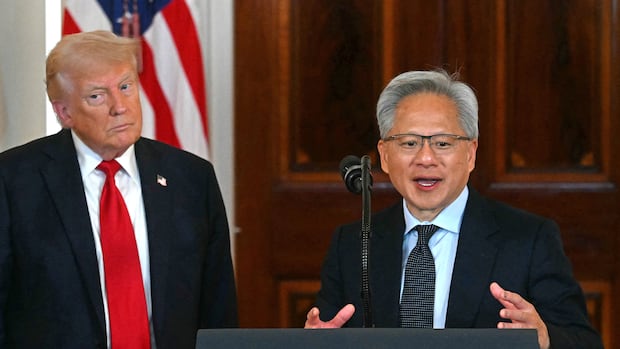
Following Nvidia CEO Jensen Huang’s admission of an affair with a suspected Chinese spy, concerns regarding the company’s governance and the broader implications for AI’s future are being raised.
What is Anthropic?
Founded in 2021, Anthropic began as a specialized AI research organization when its creators departed from OpenAI, citing concerns that the latter was overly profit-driven, disregarding potential risks, and granting excessive power to investors.
The company gained traction in 2024 with the launch of Claude 3.5 Sonnet, which surpassed OpenAI’s GPT-4o on key performance indicators while being significantly more cost-effective than earlier advanced AI models.
-
OpenAI cancels new AI model release due to safety issues
-
BMO, CIBC, RBC, TD Bank halt personal AI agents, citing safety and security concerns
-
FRONT BURNER
Will Anthropic’s IPO succeed or fail?
In contrast to companies like Apple or Microsoft, Anthropic is not a conventional profit-driven enterprise. It operates as a public benefit corporation, which requires its board to balance public safety with the goal of maximizing shareholder profits.
At present, CEO Dario Amodei of Anthropic is a prominent proponent of AI safety, advocating for the industry to decelerate advancements to allow safety protocols to keep pace.
In its latest regulatory submission to the SEC, Anthropic allocated 94 out of over 300 pages to detailing an extensive array of risk factors.
The company cautioned, “Our AI models may act in unintended, misaligned, or autonomous ways, including potentially taking harmful actions that no user or third party initiated.”
Anthropic added that this could involve “behaviors akin to blackmail or attempts to sway human decision-makers to ensure the model’s continued functionality,” along with actions that “pose catastrophic or existential threats to humanity.”
Big numbers
The $1.4 trillion US valuation is not the only striking figure linked to Anthropic’s IPO.
The company’s valuation has experienced significant volatility in recent times, with $2 trillion US previously being a consideration. In late May, private investors valued the firm at $965 billion US, a rise from $380 billion US in February.
“There’s a considerable amount of optimism embedded in these valuations as they’re emerging,” stated Taylor.
“No one can accurately predict what Anthropic will look like in five years.”

Dario Amodei, CEO and co-founder of Anthropic, participates in the annual meeting of the World Economic Forum in Davos, Switzerland, in January 2025. (Markus Schreiber/The Associated Press)
The company has seen rapid sales growth. As per regulatory documents, Anthropic generated more than three and a half times the revenue in the first half of 2026 compared to its total revenue for the previous year. Approximately 20 percent of those earnings originated from two significant unnamed clients.
Simultaneously, the AI giant has incurred substantial losses. It recorded a net loss of $80.7 billion US this year through June, largely attributed to non-cash accounting expenses. The company faced a loss of $42 billion US in 2025.
Anthropic also has ambitious spending plans. The firm does not construct or maintain physical data centers but instead leases high-performance computing resources from cloud providers like Amazon Web Services and Google Cloud through extensive multi-year service agreements.
According to regulatory filings, Anthropic has secured nearly $900 billion US in cloud and computing contracts that extend into the 2030s and 2040s. Partners in these agreements include Broadcom, SpaceX AI, Google Cloud, Amazon Web Services, and Microsoft Azure.
A blockbuster IPO
The significance of Anthropic’s IPO goes beyond its sheer magnitude.
“Investing in the Anthropic IPO represents one of the initial pure-play AI investment opportunities,” Taylor stated.
So far, investors seeking to tap into the artificial intelligence boom have largely had to settle for less AI-centric tech firms such as Microsoft or Nvidia, which produces chips. Google, for instance, is often associated with the AI investment trend, but it also operates substantial businesses unrelated to AI, including its Android smartphones and YouTube.
“Their sole focus is creating new AI models,” Wong said of Anthropic. “It’s a crucial piece of the puzzle, as public company data from various players in the AI sphere is available, except for the model creators, primarily Anthropic and OpenAI.”
If Anthropic’s IPO is regarded as a new standard for AI investment, its initial trading days will unfold amidst notable volatility in the technology sector.
Earlier this month, technology and AI stocks underwent sharp sell-offs followed by rapid rebounds as markets entered correction territory. This was partly fueled by worries about whether AI companies could match their significant expenditures with adequate profit margins. The situation was exacerbated by political concerns in the U.S. following the midterms regarding stricter regulations for AI and data centers.
Additionally, the recent controversy involving Nvidia CEO Jensen Huang’s alleged relationship with a suspected Chinese spy introduces an additional layer of apprehension regarding AI investments. The chipmaker’s stock, often seen as a bellwether for AI investments, has lost billions in market value on the Nasdaq, where Anthropic is poised to make its debut.
Like the dot com bubble?
“The primary challenge for Anthropic lies in competing with other model providers in a very competitive landscape,” Wong noted. “OpenAI develops its own models, while SpaceX through Grok is a prominent model lab. Certainly, Google and Meta are also in the race.”
He cautions that the stock may not appeal to risk-averse investors initially, as they will assess each new Anthropic product against competitors and scrutinize its extensive spending on data services.
“It will undoubtedly be quite volatile,” Wong predicted.
This has been the experience for SpaceX since its Nasdaq launch in June, which saw the stock surge approximately 19 percent on its first day. However, it has since fallen as much as 22 percent below its $135 US IPO price.
For Taylor, the substantial expenditures in the AI sector, rapid stock increases, and tight business relationships among a select few tech firms serve as reminders of a previous investment craze that dramatically differentiated winners from losers.
“The dot-com bubble is likely the most vivid example in many people’s minds,” he remarked. “Everyone was eager to invest in the internet back in 2000.”
While companies like Pets.com failed, giants like Google and Microsoft emerged as household names.
“There are many significant parallels with AI,” Taylor said. “The challenge is determining who will ultimately prevail.”