

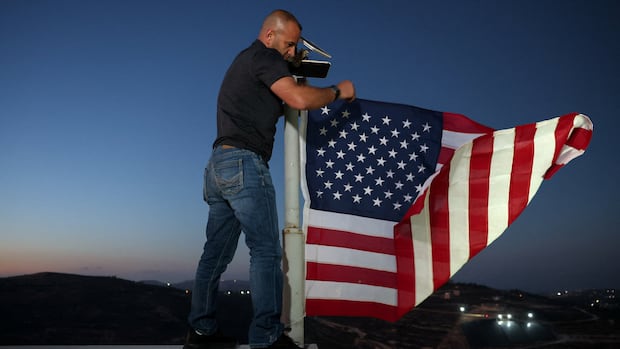

The recent encirclement of Palestinian residences by militant Israeli settlers in Qusra, a village in the occupied West Bank, is not an isolated occurrence.
However, the U.S. citizenship of one Palestinian homeowner has attracted more media focus than the frequent acts of violence committed by extreme Jewish settlers, which are typically aimed at displacing Palestinians from their lands.
Ohio businessman Loui Ridi returned to Qusra on Monday, August 17, to safeguard his home and his brother and nephew, who reside there, as settlers surrounded their property and two adjacent homes.
“I called my brother, and he said, ‘I have no food. I don’t want to leave the house, but I need food,'” Ridi shared with CBC news during a video call from Qusra after his arrival.
He explained that leaving would mean inviting settlers to take over his home.
“Just two months ago, [settlers] were at my neighbor’s village in Jalud,” he recounted. “They laid siege on the family for several weeks, and unfortunately, they succeeded in forcing them out of their own home.”
International law deems Israeli settlements in the occupied West Bank as illegal. These settlements have seen significant growth under the leadership of Israeli Prime Minister Benjamin Netanyahu and his ultranationalist coalition partners, whom critics accuse of implicitly endorsing settler violence.
Upon his return to Qusra, one of Ridi’s initial actions was to hoist an American flag atop his building. He has reached out to the U.S. Embassy for assistance.
Located around 16 kilometers south of Nablus, Qusra is encircled by settlement blocs such as Migdalim and Shilo, along with an increasing number of outposts occupied by radical settlers.
According to the UN Office for the Coordination of Humanitarian Affairs, settler assaults resulting in injuries or property damage are averaging approximately six incidents per day this year, marking “the highest rate on record.”

We hear from Loui Ridi who travelled from Ohio to the village of Qusra in the West Bank to help his brother and nephew who have been trapped in their home, after Israeli settlers surrounded their house last week. Then political analyst, Dahlia Scheindlin, on what this situation means in the larger context of surging Israeli settler violence towards Palestinians in the West Bank, and where Prime Minister Benjamin Netanyahu’s government stands on the issue.
The turmoil in Qusra drew criticism from U.S. Ambassador to Israel Mike Huckabee, who labeled those responsible as “Israeli terrorists” on social media.
“We are horrified by some of the incidents affecting families who are victims of criminal behavior that is entirely unacceptable and abhorrent,” he stated in a subsequent televised interview with Reuters.
“I refuse to refer to them as settlers,” he remarked. “They are un-settlers.”
Huckabee is a strong proponent of Israel’s settlement policy and Jewish claims to a biblical right to the land, often referring to the West Bank as Judea and Samaria.
Over 700,000 Israeli settlers inhabit the occupied Palestinian territories, including East Jerusalem. Many reside in large, well-established blocs, while others are in unauthorized outposts deemed illegal under Israeli law, at least theoretically.
Huckabee has characterized violent settlers as a small fraction of the population.
Critics argue that this perspective overlooks what they describe as a de facto institutional annexation of the West Bank that increasingly relies on violence.

A young Palestinian boy is seen at a mosque allegedly burned by Israeli settlers in the village of Qusra, south of Nablus in the Israeli-occupied West Bank on July 26. Palestinian officials said Israeli settlers set fire to two mosques in the occupied West Bank overnight on July 26, after this week’s deadly clashes in the territory left six people dead. Violence in the Israeli-occupied West Bank has surged since the Gaza war began with Hamas’s October 7, 2023 attack on Israel. (John Wessels/AFP/Getty Images)
“I believe Mr. Huckabee is overlooking the fundamental issue,” stated Dror Etkes, the founder of Kerem Navot, an Israeli NGO that monitors settlements.
“The issue is not merely the individual house in Qusra. The issue lies within the system that fosters this kind of violence,” he explained.
“The notion that Israel can govern three million Palestinians in the West Bank through military means while continuously seizing more land for Israeli settlers.”
In Qusra, Israeli border police and Israel Defence Forces (IDF) units were dispatched. The IDF stated that their forces were sent to restore order and remove settlers who were blocking Palestinian homes.
“IDF and Border Police forces took action to restore order and remove the Israeli civilians from the area,” an IDF statement indicated. They also mentioned that illegal structures erected in the vicinity had been dismantled and that troops would remain deployed.
Ridi mentioned that IDF soldiers labeled the area around his home a closed military zone and advised him to remain indoors, while permitting one settler to approach his property to intimidate him.
“I informed the IDF soldier that even though it’s a military zone, I am on my property… Your duty is to remove that settler and arrest him,” he stated.
On Friday, Reuters released a video, reportedly recorded by Ridi, showing an Israeli soldier tossing items from the balcony of one of the besieged houses in Qusra, while another soldier disposed of belongings into a well on the property.
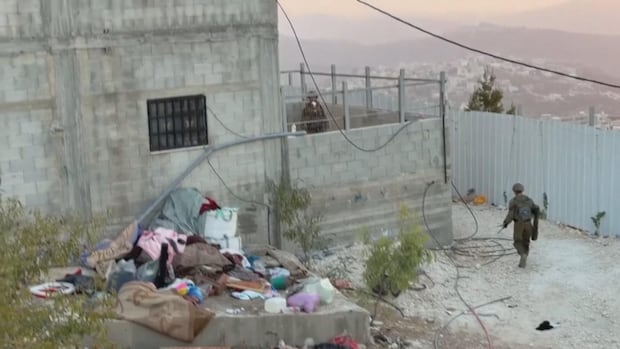
Video obtained by Reuters, filmed by Palestinian-American Loui Ridi, appears to show one Israeli soldier throwing items from the balcony of one of the besieged houses in Qusra and another dumping things into a well on the property.
For Palestinians, such incidents contribute to an increasingly blurred line between soldiers and settlers. IDF units operating within the West Bank may include ideological settlers, and the military also trains security units for settlers.
The IDF referred CBC News’ query regarding whether any Israelis had been arrested in connection with the blockade in Qusra to Israeli police, who have not yet responded.
The ongoing presence of settlers has led to a perception among Palestinians that the IDF exists to facilitate Israel’s settlement endeavors.
“If the Israeli army wanted to displace the settlers, they could do it in just one hour,” stated Rabia Odeh, 22, a resident from Qusra living on the opposite side of the village from Ridi.
“But the settlers and the Israeli army are working together, right in front of us,” she added.
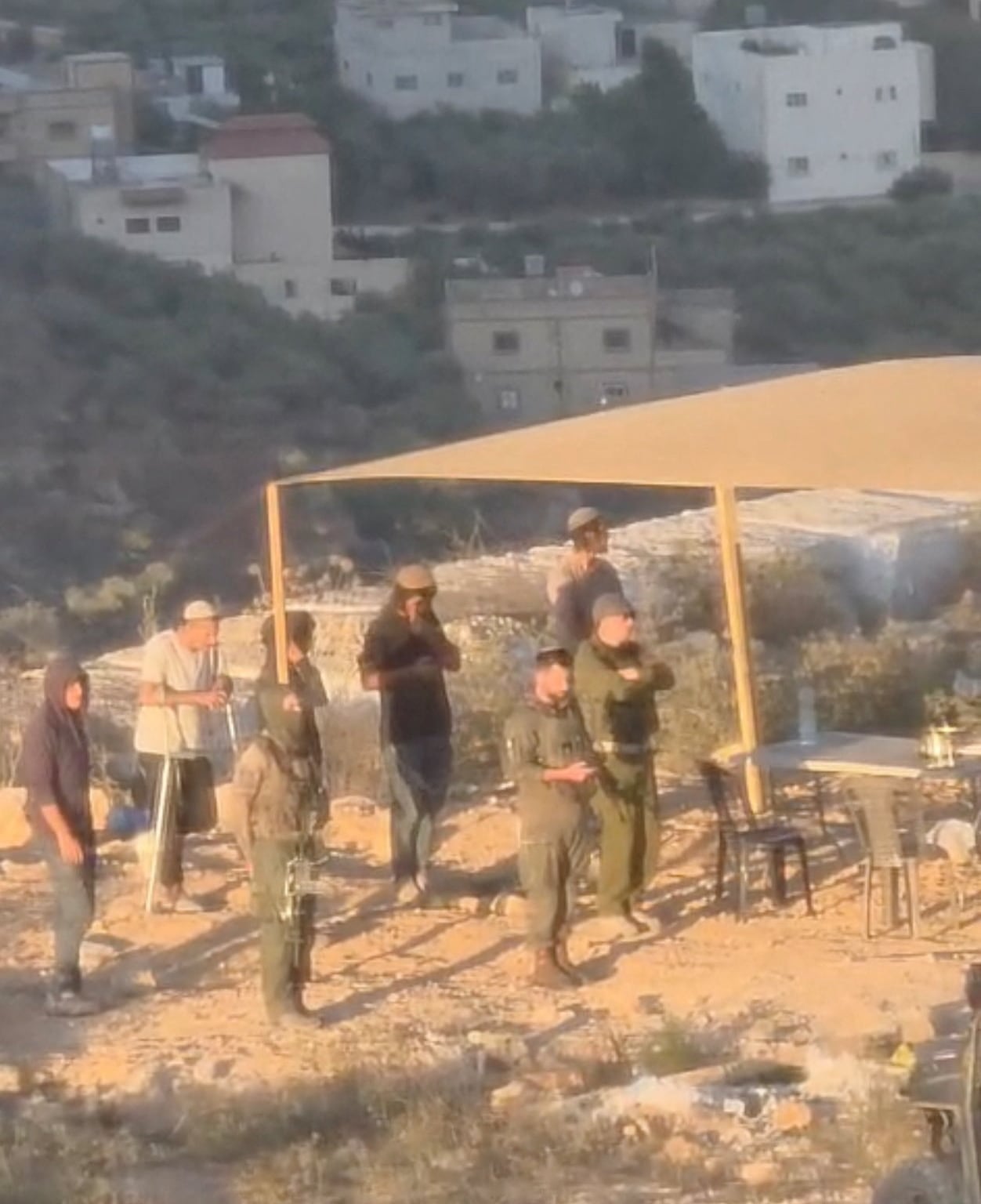
Israeli settlers and individuals in military uniforms are seen outside a Palestinian’s residence in Qusra, in the Israeli-occupied West Bank, in this screengrab taken from a handout video released August 10. (Reuters)
CBC News first encountered Odeh in the fall of 2023 after her family’s residence was attacked by militant settlers from a nearby outpost on a hill overlooking Qusra.
They hurled rocks at her house and set vehicles on fire outside.
Four Palestinians were killed in the subsequent altercation, and two additional men from the village lost their lives during the funeral.
Odeh mentioned that the outpost has expanded since that incident.
Now married and expecting her first child, she resides in a home equipped with external security cameras.
“Even when I need to visit my mother’s house, I check the cameras,” she remarked. “So if the settlers are outside, I can’t go out.”
Both Odeh’s previous and current residences are on the outskirts of Qusra, just like Ridi’s.
“What we are witnessing in the past month indicates that this violence is increasingly directed towards the edges of Palestinian populated areas,” stated Etkes.
“The goal is to minimize the space where Palestinians can reside and move,” he added.
Settlement monitoring groups claim that this strategy aims to confine Palestinians to smaller regions, facilitating the connection of settlement blocs and outposts across various parts of the West Bank.
“Qusra is perhaps one of the prime examples of what we have observed in the past month,” Etkes noted. “But this is not limited to Qusra; it is occurring in numerous other Palestinian villages throughout the West Bank.”
Settlement expansion is also progressing on a much larger scale in other areas.
On Thursday, Canada joined France, Germany, the United Kingdom, and several other nations in condemning Israel’s announcement regarding construction tenders for a new settlement called E1, located just outside occupied East Jerusalem.
“The E1 settlement will jeopardize the chances of a two-state solution by creating a divide within the West Bank and disrupting the territorial continuity of the Palestinian Territories,” a joint statement read.