

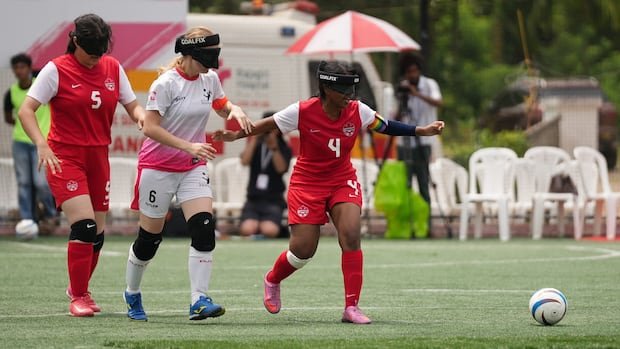

The distinct feature of blind soccer that immediately captures attention is the sound it generates. A ball equipped with small bells creates a rattling noise as it traverses the field, serving as a crucial auditory cue for players. The game heavily relies on sound cues, with teams consisting of five players each, all wearing eyeshades to ensure a level playing field regardless of varying degrees of visual impairment.
In this unique version of soccer, the sighted goalkeeper guides the team from the back, while a guide positioned behind the opposing net directs attackers towards the goal. To prevent collisions, players approaching an opponent must vocally announce “voy,” the Spanish term for “I go.”
For Canada’s women’s blind national team, introducing the sport to the populace and developing a competitive team have been ongoing challenges for nearly a decade. The team is set to compete against Argentina, Mexico, and host Brazil at the IBSA Women’s Blind Football American Championship in São Paulo, marking Canada’s second international appearance in blind soccer.
Since Matt Greenwood began involvement with the sport in 2017, the number of competitive blind soccer players in Canada has increased from eight recreational players to approximately 30 nationwide. Through workshops and community sessions, over 3,500 individuals have been introduced to the sport, with around 20% being visually impaired from birth or becoming legally blind later in life.
Captain Hillary Scanlon, who unexpectedly lost her vision in 2016, discovered blind soccer online and realized it was a Paralympic sport. Despite initially finding no Canadian program, a chance encounter with Greenwood through the Ontario Soccer website led to the establishment of the program in 2022.
Apart from the absence of a structured program, another challenge in blind soccer is the scarcity of echo boards, crucial for player orientation on the field. Canada possesses only one set of echo boards, left over from the 2015 Parapan American Games and situated near Lake Joseph in Muskoka, far from the national team’s training base in Pickering.
Expanding blind soccer across the vast expanse of Canada poses its own set of difficulties, with programs concentrated in select regions like Ontario, Burnaby (B.C.), and Halifax. Players often undertake long journeys to attend training sessions, with Scanlon commuting for hours weekly to train in Pickering, along with teammates residing in distant locations such as Sudbury and Alberta.
Following their debut at the world championship where Canada finished in eighth place, the national team gained valuable experience and was awarded the tournament’s fair play accolade. To participate in sanctioned international events, a program necessitates an official national governing body, leading to Canada Soccer assuming responsibility for blind soccer in 2025 after collaboration with the CBSA.
Canada Soccer’s partnership with Soccability Canada has facilitated the program’s administration, covering various expenses such as uniforms, travel insurance, and a portion of registration and classification fees for IBSA events. Sport Canada has recommended targeted core funding to support blind and Para soccer activities, aiding in training camps, coaching, and international competition, albeit the expenses for the Brazil tournament are met through fundraising efforts and personal contributions by players.
From a time when blind soccer in Canada was virtually non-existent to now fielding a national team heading to Brazil, the progress achieved signifies a significant milestone. Greenwood, amidst years of dedicated efforts in fundraising, organization, coaching, and overcoming unique challenges, eagerly anticipates the moment when the players step onto the field together.