

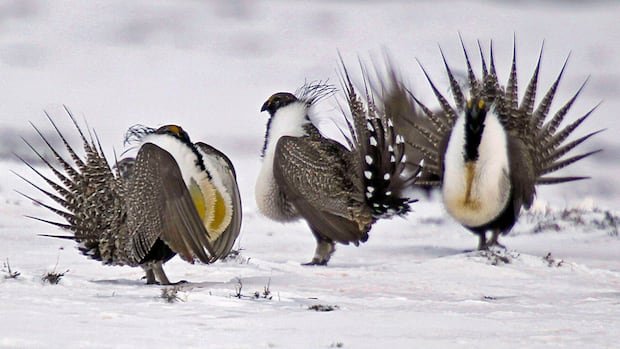

The Alberta government has eliminated habitat protections for the endangered greater sage grouse, as part of amendments to the Public Lands Act in July. This move has raised concerns about the future of the remaining population of these birds in Alberta, estimated to be fewer than 100 individuals mainly restricted to the southeastern corner of the province.
The population of the greater sage grouse in Alberta has experienced a drastic 98% decline from 1968 to 2012, largely due to habitat loss and industrial development. University of Alberta ecology professor Mark Boyce, a longtime advocate for greater sage grouse conservation, warns that the removal of provincial protections directly endangers the survival of these birds in Alberta.
Boyce criticized the Alberta government for prioritizing industrial development over conservation efforts, expressing grave concerns about the potential extinction of the species. The removal of habitat protections has been met with criticism from conservationists, who fear that decades of work to help the species recover are now at risk.
In response to the backlash, Alberta Environment and Protected Areas communications director Andrew Livingstone defended the changes, stating that they aim to simplify regulatory requirements and provide flexibility for proponents operating in southeastern Alberta. Livingstone emphasized that Alberta remains committed to supporting a sage grouse recovery program while balancing conservation goals with economic needs.
While federal protections for a portion of Alberta’s greater sage grouse habitat are still in place, the removal of provincial regulations has significantly impacted conservation efforts. The decision to lift habitat protections was reportedly influenced by the helium industry, which advocated for these changes to support economic development.
Thor Resources, a helium extraction company operating in greater sage grouse habitat, indicated that the removal of provincial protections has altered their operational requirements. Despite commitments to maintain certain environmental standards, the company no longer has specific obligations regarding greater sage grouse conservation in the affected areas.
Industry representatives, including Richard Dunn from the Helium Developers Association of Canada, justified the removal of habitat protections as a necessary step to balance environmental concerns with economic interests. Dunn argued that the previous restrictions were overly burdensome and hindered economic development in the region.
The ongoing debate between conservationists, industry stakeholders, and government officials underscores the complex challenges of environmental protection and resource development in Alberta, particularly concerning the endangered greater sage grouse population.