

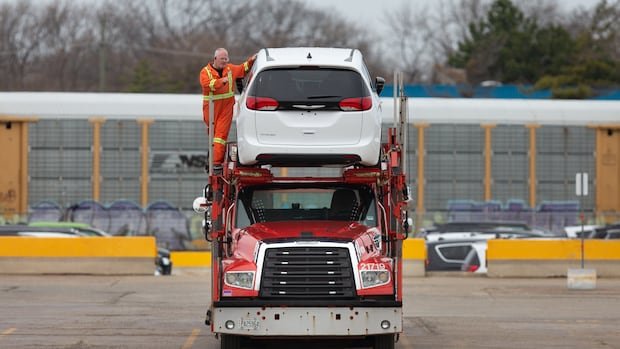

U.S. President Donald Trump’s trade envoy’s recent statements regarding Canada’s automotive sector highlight the ongoing challenge posed by its deep integration within North America if negotiations resume. Trump and U.S. Commerce Secretary Howard Lutnick have emphasized the administration’s desire to shift Canadian auto manufacturing jobs to the U.S.
In an exclusive interview with CBC News, U.S. Trade Representative Jamieson Greer discussed the future of the integrated auto industry shared by the U.S. and Canada. Greer acknowledged the significant employment gap in U.S. manufacturing, with the automotive sector playing a crucial role in this.
Expressing concerns about the negative impacts of globalization on U.S. states like Michigan, Ohio, Pennsylvania, and Wisconsin, Greer emphasized the administration’s focus on revitalizing American industries. While Canada aims to secure favorable terms, Greer stressed the priority of American interests in the negotiations.
Canada’s Ambassador to the U.S., Mark Wiseman, emphasized the importance of protecting the auto industry in Canada, particularly in Ontario and Quebec. The failure of recent trade talks was attributed to unresolved issues, including U.S. tariffs on Canadian auto parts and finished vehicles.
Greer clarified that the discussions on heavy- and medium-duty trucks were distinct from auto tariffs, indicating the administration’s willingness to lower tariffs in the latter case. Trump’s intention to relocate auto assembly away from Canada has been widely communicated, with the president advocating for domestic production.
Industry stakeholders, including Flavio Volpe and Brian Kingston, expressed varying sentiments on the negotiations. While Kingston viewed the breakdown as an opportunity for constructive dialogue, Volpe cautioned against the detrimental effects of prolonged trade tensions on the North American auto industry.
Despite the impasse, there remains optimism for a resolution, with calls for a return to negotiation and de-escalation of tariff threats. Volpe highlighted the importance of recognizing the interconnected nature of the auto sectors in both countries, emphasizing the need for mutual cooperation in future trade agreements.