

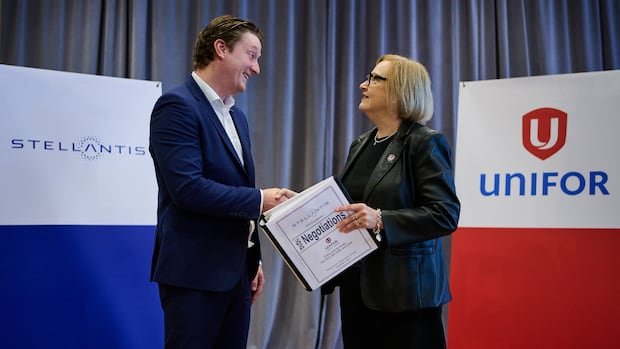

The union representing employees at Stellantis has cautioned the U.S. automaker against underestimating Canadian workers as Unifor and the company initiated contract discussions on Tuesday. These negotiations signify the final phase of Unifor’s talks with the Detroit Three automakers, employing a pattern bargaining approach to establish terms for potential replication with other firms.
Despite successfully endorsing fresh collective agreements with Ford Motor Co. and General Motors in Canada earlier this year, Unifor’s national president Lana Payne acknowledged the upcoming talks present the union’s most formidable challenge. She acknowledged the turbulent circumstances, including uncertainties, tariffs, and trade disputes during a news briefing.
The ongoing discussions aim to secure a new agreement by September 11. Job security, particularly after over 2,000 employees were laid off from Stellantis’ Brampton, Ont., assembly plant, remains a primary concern for the union. The plant has been inactive since 2023 and faces potential closure or sale, as revealed by the union last month.
Payne expressed discontent over Stellantis relocating Jeep Compass production to the U.S., violating the existing collective agreement. She emphasized the importance of rectifying relations with workers at the Brampton Assembly plant by reinstating their roles in vehicle manufacturing.
Stellantis emphasized the significance of labor negotiations for its future, acknowledging the evolving trade and regulatory landscape affecting the automotive sector in Canada. The company highlighted its substantial investments in Canadian operations since 2022, emphasizing its commitment to the Canadian market.
Amidst the negotiations, the impact of U.S. tariffs on local automakers remains a pressing concern. Payne stressed the critical need for Canada to protect its auto industry from potential detrimental consequences of escalated tariffs proposed by U.S. President Donald Trump.
Larry Savage, a labor studies professor, noted the dual challenges facing Unifor in maintaining vehicle production in Canada while advocating against trade agreements that could jeopardize the auto industry. He underlined the union’s efforts to safeguard the industry’s future amidst external pressures.
The recent ratification of new contracts by General Motors employees, with significant support from various locations, reflects the ongoing success of Unifor in securing favorable terms for its members. The agreements entail wage increases and mirror the patterns established in negotiations with other automakers.