
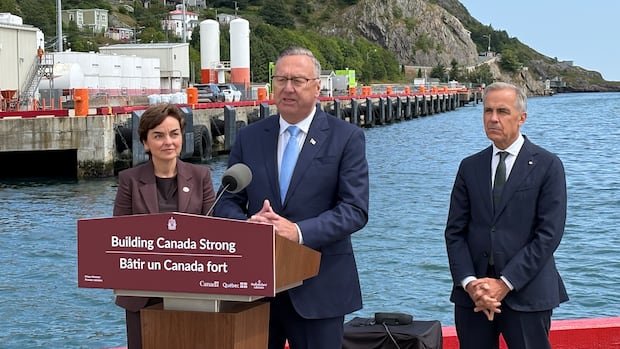

Ottawa has described it as the most significant investment in clean energy ever made in North America. Prime Minister Mark Carney visited St. John’s on Monday to unveil a groundbreaking agreement concerning Churchill Falls and other electricity ventures in Labrador, standing alongside N.L. Premier Tony Wakeham and Quebec Premier Christine Fréchette.
Wakeham expressed, “We are finally turning the page on one of the darkest chapters in our past, and replacing both the notorious 1969 Churchill Falls agreement and the 2024 memorandum of understanding with a better deal for all of us.” The leaders convened on Pier 17 against a stunning ocean backdrop to present the new deal’s specifics.
Under the agreement, Ottawa will allocate $10 billion for enhancing and expanding the Churchill Falls generating station, developing the Gull Island hydroelectric project, constructing transmission lines, and initiating a 2,000 MW onshore wind energy project in Labrador. These projects, valued at nearly $70 billion, mark the largest clean energy investment in North American history. They will almost triple the current generating capacity of Churchill Falls, generating enough power to illuminate, heat, and cool all the residences in Toronto, Montreal, and Vancouver combined.
Carney emphasized, “Tripling the current generation capacity of Churchill Falls to 14,000 megawatts of renewable power surpasses the entire generating capacity of B.C. Hydro and doubles the output of Bruce Power, the largest nuclear plant on this continent.” The projects are anticipated to create 23,000 jobs, as stated by both government levels.
The deal is designed to offer Quebec a secure power source while N.L. aims to derive additional revenue from natural resources amid substantial debt. Moreover, it aims to reduce electricity costs for Newfoundlanders and Labradorians. A new 15% rebate on the first 2,000 kWh of monthly electricity usage will be granted to all N.L. ratepayers, resulting in an average annual household savings of $351.
Describing the agreement as a “win-win-win,” Wakeham highlighted that the updated figures in the new tentative agreement between Newfoundland and Labrador Hydro and Hydro-Quebec outshine those of the previous 2024 memorandum of understanding. The deal’s net present value for N.L. is estimated to rise from $36 billion to $49 billion.
The agreement, effective until March 31, 2027, unless mutually amended or definitive agreements are signed earlier, could face complications due to the upcoming Quebec election. However, Wakeham remains optimistic, emphasizing the benefits for N.L. in terms of power, value, and transmission.
The agreement includes provisions for studying a potential expansion of the Churchill Falls facility, with upgrades to boost its capacity by 23.5%, or 1,275 MW. Additionally, the agreement will provide Newfoundland and Labrador with approximately 760 MW more power, potentially reaching 2,750 MW with the completion of the wind project.
Hydro-Quebec will gain access to up to 6,915 MW, expanding to 8,515 MW if the wind project materializes. The agreement also stipulates payment terms, with Hydro-Quebec set to pay 1.8 cents per kilowatt-hour next year, gradually increasing to 11.5 cents by 2041.
Furthermore, Ottawa plans to offer a loan guarantee for Gull Island construction costs and engage in the development of a new wind project facility. The additional power is expected to bolster Labrador’s mining industry. Natural Resources Canada will provide funding for engineering studies on transmission lines to enhance power supply to Labrador west and support the Kami iron ore project’s development.
In the face of the upcoming Quebec election, the durability of the agreement was questioned. Fréchette endorsed the deal as beneficial for Quebec, highlighting the creation of jobs and the substantial power increase. She challenged critics by questioning alternative plans to secure the significant energy and job opportunities provided by the agreement.
The agreement aims to benefit both provinces mutually and secure long-term clean energy investments, offering economic growth and sustainability benefits for years to come.