

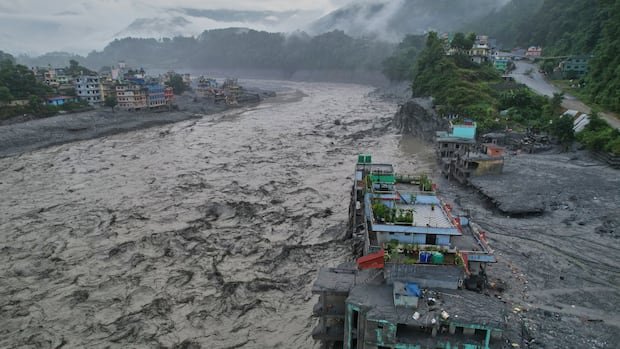

Authorities in Nepal have issued warnings of potential new flooding, advising residents in affected areas to stay vigilant as water levels in the Bhotekoshi River have risen. Flood alerts were sent to people’s mobile phones early on Sunday as rescue teams worked to clear a major highway linking Kathmandu to one of the hardest-hit regions by the catastrophic floods last Wednesday, resulting in at least 800 fatalities and over 3,000 individuals missing in Nepal and Tibet.
The recent alerts followed communication from Chinese authorities to their Nepalese counterparts regarding increased water flow upstream. According to Dharam Raj Uprety, head of Nepal’s National Disaster Risk Reduction and Management Authority, Chinese state news agency Xinhua reported that a newly formed lake following the floods in high mountain regions had mostly drained. However, the Ministry of Water Resources cautioned about a crater situated 5.6 kilometers upstream, holding approximately 1.4 million cubic meters of water, which still posed a potential risk necessitating close monitoring.
As of Sunday, Nepal’s disaster agency confirmed a death toll of 788 with 2,502 individuals missing, while Chinese authorities reported 16 casualties and 546 missing on their side of the border. Among the missing are hundreds of individuals from various countries who were in the area for work, tourism, or religious purposes. In Tibet, Chinese state media disclosed that 261 foreigners, including over 100 Nepalis and others from different nations, were unaccounted for.
Canada’s Foreign Affairs Minister Anita Anand announced on social media that a previously missing Canadian had been found safe. However, 31 Canadians remain unaccounted for, with the number subject to change as more information becomes available. Families in Canada, like Seema Rawla’s, whose brother is among the missing, are seeking the government’s assistance and have urged for resources and support to aid in the search efforts.
Rescue operations are underway at multiple hydroelectric projects, including a significant operation at the Upper Trishuli complex where approximately 350 individuals are believed to be trapped inside a tunnel. Around 10,000 Nepali troops, along with specialists from China and India, have been deployed for the tunnel rescue missions.
In the aftermath of the devastating floods, some residents in Nepal have started returning to their destroyed homes to salvage belongings. The destruction caused by the floods has left communities grappling with challenges like destroyed bridges, lack of easy access, and power outages in areas that were spared from complete devastation.
The flash floods in Nepal were triggered by a glacial collapse high in the Himalayan region. The resulting torrent of water caused widespread destruction in Tibet and Nepal. The foreign affairs minister of Nepal has highlighted the disproportionate impact of climate change on the country, emphasizing the urgent need for a global response to address the escalating climate crisis affecting vulnerable regions like Nepal.
Scientists have noted the increased risks of such disasters in warming regions like the Himalayas due to human-induced global warming. While it is early to establish a direct link between global warming and the recent catastrophe, the warming temperatures in the Himalayan mountains are indicative of the escalating climate challenges faced by vulnerable communities.
The situation remains critical as both Nepal and Tibet grapple with the aftermath of the devastating floods, with rescue efforts ongoing and communities facing the arduous task of rebuilding in the wake of unprecedented destruction.