

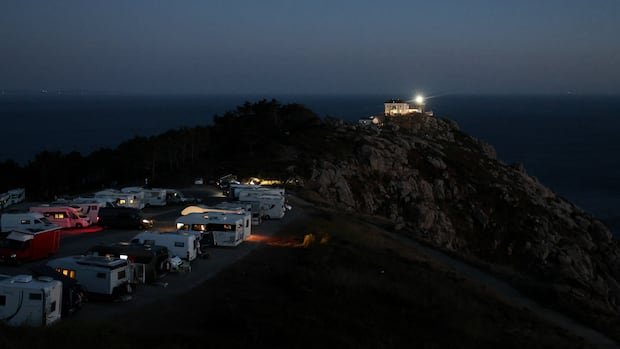

Hundreds of thousands of visitors have flocked to Spain in anticipation of witnessing the solar eclipse occurring on Wednesday. However, with soaring temperatures and a heightened wildfire risk in the country, authorities are concerned about potential fire damage resulting from the surge in astrotourism.
Virginia Barcones, the secretary general for civil protection and emergencies at Spain’s Interior Ministry, emphasized the need to curb activities that could spark fires due to the challenging summer marked by significant forest fires. Across Europe, a heatwave has persisted since May, exacerbating Spain’s ongoing wildfire season. The European Forest Fire Information System reports that approximately 603,000 acres (2,440 square kilometers) of land have succumbed to about 400 fires this year.
To prevent eclipse tourists from adding to these statistics, authorities are mobilizing 35,000 officers to monitor large outdoor gatherings on Wednesday, aiming to detect and prevent any potential fire outbreaks. Spain stands out as a prime spot to witness the solar eclipse, with the path of totality spanning northern Russia, eastern Greenland, western Iceland, the northeastern tip of Portugal, and a wide region across northern Spain, encompassing the Balearic Islands where approximately 15 million people reside.
Only individuals within the path of totality will witness the moon completely obscuring the sun. While Canada will experience a partial eclipse, viewers are advised to use eclipse glasses for eye protection. This astronomical event marks the first full solar eclipse visible from mainland Spain in 120 years, triggering a surge in travel interest.
Special measures sanctioned by the Ministry of the Interior were announced earlier this summer to manage the anticipated crowds for the solar eclipse. Search activities for accommodations along the path of totality surged as the event neared, with Valencia recording a 245% increase in searches compared to the previous year, as reported by Expedia Group.
Regional authorities have designated 660 official viewing sites to accommodate over 440,000 expected attendees, with an estimated 1.5 million individuals projected to be on the move to reach these locations. Both national and local authorities caution tourists against using barbecues or venturing into dry areas where fire risks are heightened.
The solar eclipse is forecasted to inject over 347 million euros into Spain’s economy, according to a recent economic impact study by the Ministry of Economy, Trade, and Business. Despite prevailing dry conditions and fire concerns, the enthusiasm among eclipse travelers remains high.
While three major wildfires continue to blaze in Huelva, Segovia, and Huesca provinces, authorities are particularly monitoring the Las Peñas de Riglos wildfire north of Zaragoza, which poses risks to astro-tourists. AEMET, Spain’s meteorological agency, predicts very high or extreme forest fire indices across the Iberian Peninsula and the Balearic Islands on the day of the eclipse.
With temperatures expected to soar on eclipse day, reaching up to 35°C and even 40°C in certain regions, AEMET warns of the elevated risk of wildfires. Although the eclipse will reach totality in Reykjavík, Iceland, at 5:48 p.m. local time, viewers in Spain will witness the event just before sunset, with northwestern Spain experiencing totality around 8:28 p.m. local time.
Amid the eclipse fervor and natural phenomena, travelers remain undeterred by heat waves and wildfires, driven by the awe-inspiring spectacle of nature. The event signifies a shared experience that transcends scientific knowledge and encourages reflection on the broader impacts of climate change.
The 2026 solar eclipse is the initial installment in a series of celestial events visible from Spain in the coming years. Subsequent solar eclipses are scheduled for Aug. 2, 2027, and Jan. 26, 2028, respectively, with the 2027 eclipse anticipated to elevate astrotourism further as it traverses southern Spain before continuing into North Africa.