

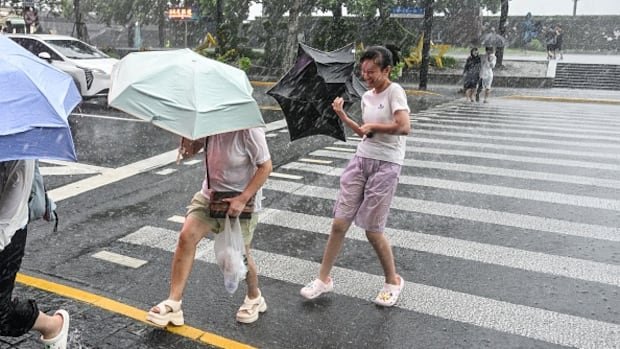

Shanghai’s airports were forced to cancel a significant number of flights on Monday due to tropical storm Dolphin bringing heavy rainfall to eastern China. The storm, which had made landfall as a typhoon the day before, caused flooding in various areas. Shanghai’s Hongqiao and Pudong airports collectively cancelled over 900 flights, which accounted for approximately 40% of the scheduled flights. This came after around 1,300 flights were cancelled the previous day, as reported by Shanghai Airport Group.
In response to the severe weather conditions, Shanghai suspended some of its metro lines, while China Railway Chengdu Group halted 115 trains. Authorities issued warnings about potential severe flooding and landslides in certain regions. In Zhejiang province’s city of Yueqing, officials conducted search and rescue operations for individuals trapped in flooded homes.
The China Meteorological Administration stated that Dolphin was moving in a northwest direction at a speed of 15 to 20 kilometers per hour and was expected to weaken further. The storm had hit Taizhou, Zhejiang province, on Sunday evening with winds reaching 151 kilometers per hour after affecting northern Taiwan with heavy rains over the weekend.
Additionally, Dolphin led to the evacuation of over 760,000 people, including more than 390,000 individuals in Taizhou alone. Shanghai and Fujian province also evacuated more than 210,000 and 160,000 people, respectively, from high-risk areas. In Hangzhou, the capital city of Zhejiang, iconic tourist spots like West Lake were temporarily closed but are set to reopen on Tuesday.
While Dolphin’s impact was felt in China, another tropical storm, Chan-hom, was on track towards Japan’s Pacific coast. The storm, with wind speeds of 83 kilometers per hour on Monday, was predicted to slightly intensify before making landfall between Tuesday and Wednesday, according to the Japan Meteorological Agency.
In Shanghai, residents shared livestreams showing flooded streets in suburban districts despite the storm passing. The persistent heavy rain caused inconvenience, with some areas experiencing knee-high water levels. A local resident, Hou Lina, expressed surprise at the extent of flooding, highlighting it as the most severe she had witnessed in her ten years in Shanghai.
Looking ahead, Beijing is bracing for significant rainfall as Dolphin continues to move inland towards central provinces like Hubei and Henan. Authorities in the capital have issued warnings for torrential rain, urging preparedness for potential flash floods and landslides. The storm, which traveled a considerable distance before hitting land, is expected to impact Beijing, Tianjin, and Hebei with heavy rainfall.
Comparisons were drawn between Dolphin and the 2023 typhoon Doksuri, which caused significant damage in southeastern Fujian and record-breaking rainfall in Beijing. The storm clouds meeting colder air in the northern regions could lead to heavy rain in Beijing, Tianjin, and Hebei until Thursday, as per CCTV reports.
As the storm season unfolds, experts predict an active northwest Pacific typhoon season, anticipating 28 tropical storms, 20 typhoons, and 13 intense typhoons. Factors contributing to this heightened activity include the ongoing strong El Niño event and weakened trade winds in the northwest Pacific basin. Though Dolphin did not directly hit the Philippines, it intensified monsoon rains, triggering floods and landslides in the Luzon region, leading to casualties and displacements.